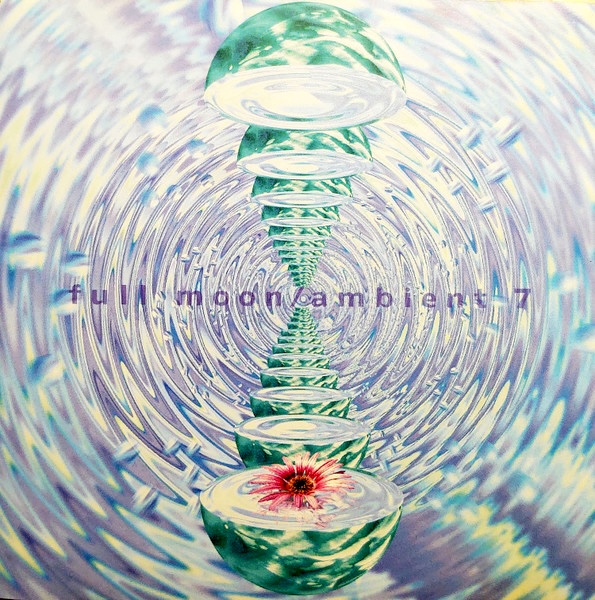
With summer winding down, my mind drifts to albums like Ambient7’s Full Moon. Ostensibly, it’s something you’d find (if you can find it) tucked under the IDM or ambient dividers, but Full Moon adds up to more than the genre it’s filed in. To me, it’s a longing, windswept collection of songs that perfectly capture the seasonal sounds of other late-summer classics. It’s a special release that showed how certain members of the group could use all they’d lived through to reimagine their own creation stories.
For those who first discovered Ambient7 through Eiji’s and Jamie’s (RIP) Virtual Dreams II (Ambient Explorations in the House & Techno Age, Japan 1993–1999), Full Moon might sound at first like a bit of a left-field turn. Far from the gently percolating, languid track “Escape” (the one chosen for that compilation), the opening cut of their sophomore release, “Kyoto,” offers a more muscular, expansive take on “ambient music.” Then, moving straight into the next track, “C.N.L.,” you really feel the sea change in their sound: the introduction of Chika Asamoto’s meditative soprano sax. What was once a band steeped in au courant production became one more in tune with their original inspirations.

There was a time when one of Ambient7’s lead composers, Chika Asamoto, was on a different trajectory entirely. Born in Osaka in 1960, Chika followed the path many Japanese kids did: studying piano with her parents’ support. At that point, mainstream Western pop and rock played a huge part in her life—so much so that it inspired her to spend time in the U.S. as a foreign exchange student, transferring out of her psychology studies at Tokyo’s Nanzan College.
As the story goes, it was her time in America—working under the table as a waitress in a Los Angeles music club—that introduced her to a different world of music, and the instrument that would become her voice. Having never experienced improvisational jazz in person, one night she saw performances from the likes of Art Pepper and George Cables. That was enough. She bought a secondhand soprano sax, applied, and was accepted at Boston’s Berklee College of Music—after just a year of practice. At that point, jazz wasn’t just a passion; it was her entire life. She practiced endlessly, day and night, either on her own or under the guidance of legendary woodwind teachers Joseph Viola and Joseph Allard.
It’s not often a late bloomer carves out the kind of career Chika did, but by the mid-’80s, under the influence of artists like Miles Davis, Stevie Wonder, and Quincy Jones, she returned home and joined the Japanese fusion band Crystal Moon (as Asamoto Chica), playing alto sax and collaborating with artists like Shinji Harada and Hideki Andoh before going solo. In an era when female Japanese jazz soloists were rare, Chika was determined to risk everything and pursue a sound that felt more her own.
As a solo artist, now under the name Chika Asamoto, Columbia Japan gave her the freedom to shape a distinct blend of jazz and contemporary music. On albums like 1988’s Gypsy Moon you can hear her seamless fusion of smooth jazz, jazz-funk, New Jack Swing, and New Music. It’s one of those Japanese jazz records that leaned more toward commercial success than to the BGM or “listening bar” ghetto. Seeds of Ambient7 are there too—especially in tracks like “Obsession,” inspired more by impressionistic New Age music.

Later albums—1991’s Heartland Chic with its atmospheric touches (“Wild Life,” “La Lunna”), and 1992’s Embouchure, which mixed complex jazz with R&B-infused popcraft—showed her growing ambitions. By 1994’s Asian Hearts, though, you get the sense her heart wasn’t as much in jazz anymore. Fame had its own baggage, and although she’d become more than just a musician (with TV and commercial appearances), by the mid-’90s she was splitting her time between Japan and Bali, looking for something else, somewhere else.
It was during that period abroad that Chika found new direction. Supporting gigs brought her into contact with artists like Jon Hassell, Tineke Postma, and Wayne Shorter, while the underground dance scene— through acts like System 7—gave her a glimpse of where her music might go. She saw how jazz could find footing in chill-out rooms, in trance, in downtempo. In 1994, alongside keyboardist Masayuki Momo and engineer Shuichi Ikebuchi, she formed Ambient7 to explore that world.

Momo, an Osaka native, had already established himself as a versatile programmer, arranger, and producer throughout the late ’80s and early ’90s. Starting out at Studio Take Four and Tea House, then moving into more professional roles at Studio Music Island, he worked on albums, commercials, amusement BGM, and video projects—while also developing sampler software and assisting with recording sessions. Ikebuchi, meanwhile, came in through his work as a recording engineer for artists like Toshinori Kondo and DJ Krush, equally at home cutting live mixes on stage or in the studio.
As Ambient7, their 1995 debut Escape became the first release on their own ALP Records, distributed by indie powerhouse UK Project Inc. Billed as music for a new “Alternative People,” it translated their live club performances into a studio document. Tracks like “Water Forests” sit firmly in the lineage of Brian Eno and The Orb, while “Sedap Salam” and “Escape” call to mind The KLF and early downtempo. It’s a fascinating debut—more about texture than melody—and it isn’t until later songs like “Sanctuary” or the closing “Epilogue” (with Chika’s saxophone, now so integral to their sound) that you sense where they could go.
Which is maybe why their next detour, 1996’s one-off project Cosmic Surf (Primitive), feels like a pivot point. A 4-track maxi-single—remember those?—made with vocalist Cindy, it leaned into groove and house-inspired textures. Songs like “Soshu Yakyoku (I’ll Give You Love)” (a rework of Ryoichi Hattori’s Japanese ballad standard) and “Orange Sunshine” feel like amuse bouche for the Walearic heights they’d later scale, while both versions of “Hana” (reworking Shoukichi Kina’s originals) are atmospheric house music in the vein of 808 State’s “Pacific State.” And in its quieter moments, Chika’s sax takes the music somewhere more personal and wistful. This was Ambient7 learning how to balance all their influences.

That human touch—less sequenced, more hands-on—is why I recommend Full Moon as the true entry point into Ambient7. Opening track “Kyoto” zips past with mercurial energy, pulling you into a maze of dance grooves inspired by the ancient city. Then there’s “C.N.L.,” nearly 25 minutes long, which plays like their mission statement, if not their masterpiece: a tour de force of ambient jazz, techno, and experimental sound inspired by a full moon over Bali, grounded in Chika’s yearning soprano sax and blossoming into a squelchy, sun-setting meditation.
If you’d heard their contribution to the Ambient Aromatherapy compilation—“Rosmarinus Officinalis (ローズマリー)”—you’ll recognize its aquatic, womb-like mood reintroduced here as “Lotus,” fitting seamlessly into the warmer electronics of the record. “Osaka” refracts Detroit techno through the neon glow of Amerika-mura, while “Ether” and “Pepiku” showcase some of the most emotionally resonant Japanese ambient techno of the ’90s.
As the record winds down with “August,” that floating quality lingers—a reminder that while Full Moon may not have made the splash the band hoped for, its ripples spread wide.
Now, I’m pleasantly surprised, that nearly thirty years later, those resonances are still traveling, still giving us small moments of stillness between the waves.