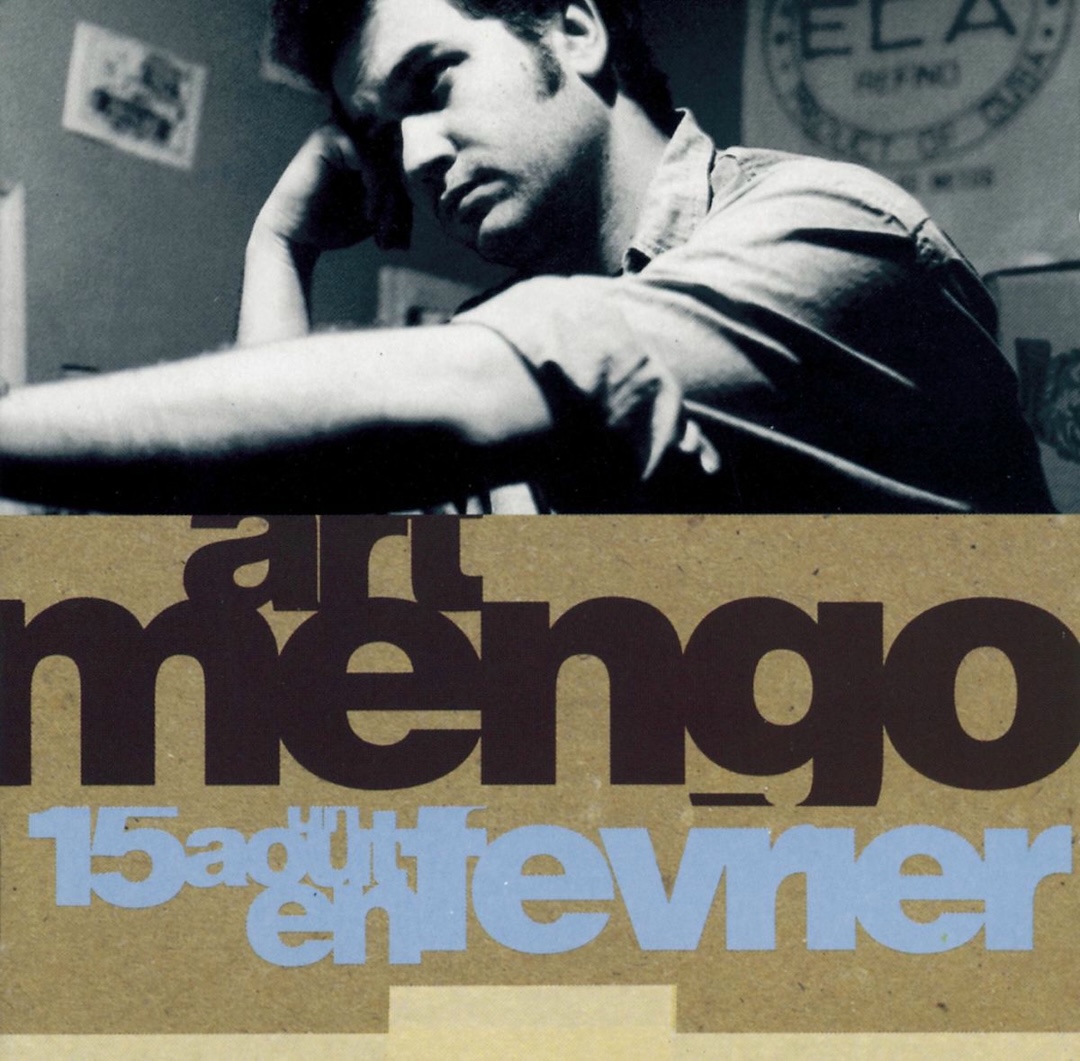
One can’t bat 100, nor make every shot a hole in one. However, if one is lucky, one should celebrate something that’s a hit with everyone. If one is fortunate, one should celebrate something that hits precious few. Yet, if one is blessed, one should celebrate those choice moments that only one can appreciate. I say all this because I’m thinking of Art Mengo’s Un 15 Août En Février—a great introduction to the intimate music of someone who might just be inside everyone’s wheelhouse.
As Art stated himself: J’ai fait deux succès (“Les parfums de sa vie”, “Parler d’amour”), trois succès d’estime (“Gino”, “Laisse-moi partir”, “La mer n’existe pas”) et… cinquante-trois succès intimes.”

Art’s name isn’t one floating on the tip of even the deepest Francophile’s tongue. Heck, I wager in Art’s heart of hearts he probably would want it that way. Fittingly, Art’s music is characterized by its deep tie to intimacy and doesn’t lend itself to sloganeering or anthemization. Of his few “hits,” universality seems the more appropriate word for the emotions he touches with his music. His songs are the kind you put on in life’s quieter moments.

Born in 1962 in Toulouse, France, Michel Armengot (Art Mengo) was the son of Spanish immigrants from Valencia, who fled Franco’s far-right nationalist government (much like F/S favorite Serge Guirao). Early on, no one expected him to gravitate toward music. His parents struggled to integrate into a French society unaccustomed to a growing immigrant diaspora, while also trying to immerse their children in a culture where holding on to one’s roots was difficult, if not impossible. On top of that, Art was born almost completely deaf.
Throughout his youth and adolescence, he retreated into himself, overcome by a deep introversion tied to his lack of hearing. It was his mother who coaxed him out of his shell by giving him a keyboard to play. By the time he was old enough to undergo surgery that alleviated his disability, the intimate connection he’d developed with music had already flowered into something else.
At first, Art pursued a career in physics and chemistry, but gave that up to perform in cafés—supporting himself as a warehouse worker for Renault. In those quiet evenings away from work, he bought a tape recorder and began capturing a collection of songs, with lyrics by his brother-in-law, Patrice Guirao (no relation to the other Guirao).
Influenced by Tom Jobim, Errol Garner, and The Beatles, Art’s music felt different from the chansonniers of his era. His songs leaned less on edgy experimentalism or overt sexuality, and more on sophistication, sensuality, and subtlety. More Claude Nougaro than Serge Gainsbourg, his voice stood out precisely because of this difference. On the strength of his demo tape, CBS France signed him—granting him a freedom most debut artists could only envy: to produce, perform, and arrange all of his own music.
Long out of print, Art’s 1990 debut Un 15 Août En Février contains one of the most popular songs he ever created. Its first single, “Les Parfums De Sa Vie (Je L’ai Tant Aimée)”, released two years prior, fused chanson with electropop in a way that foreshadowed the coming “French touch.” Tracks like this showed Art at his best: moody yet danceable, dark yet intimate, a torch ballad perfectly suited to a burgeoning alternative era ready for slippery romanticism. The follow-up single, “Demain, Demain,” bore the influence of sophisti-pop contemporaries like Prefab Sprout and Scritti Politti.

Beneath Un 15 Août En Février, you can hear the sands of musical time shifting. Songs like opening track “Où Trouver Les Violons”—featuring one of Dimitri From Paris’s earliest and best remixes—capture a home-spun, groovy, jazzy troubadour spirit that Art could reach for. Personal favorites like “Le Petit Prince” weave impressionist lyricism into mercurial Balearic songcraft, imbued with the melancholia and longing that define much of Art’s music.
In his final CBS single, “Caïd Ali,” Art defied government censors during the height of the first Gulf War with a song that sought to understand the humanity of immigrants arriving in France from the fallout of “nation-building.” Brilliantly multi-layered, both sonically and lyrically, tracks like this led him to win France’s Victoire de la Musique award for Best New Male Artist.
But after releasing this record, just as his popularity peaked, record label issues prevented him from cresting on his fame. Even releasing a follow-up became a battle. It’s here I urge you to dig further into what he created next: the soulful, house-influenced Guerre D’Amour (1992), and his long-awaited return three years later with La Mer N’existe Pas. These works proved he was not a one-hit wonder but a songwriter’s songwriter, one who also penned material for the likes of Johnny Hallyday and Juliette Gréco.

For now, at least, we have this window open onto another slice of chanson—one that warrants deeper exploration.