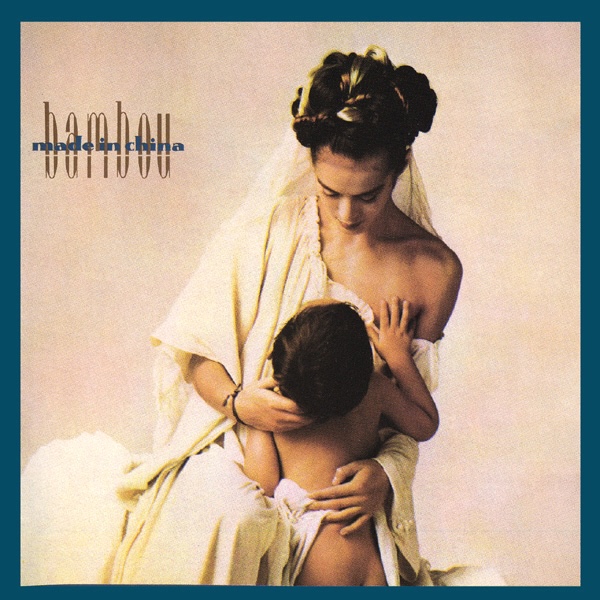
The more I dig into the story behind Bambou’s Made In China, the more I realize there’s a reason for the phrase “Who am I to judge?” As much as I don’t want to tie its story to its backstory, one can’t help but see that all its roads lead back to one person: Serge Gainsbourg.
It was in the early ’80s, at some Parisian nightclub — the Élysée-Matignon — where Serge first set his eyes on an “exotic,” tall, slender debutante who frequented the same scene he did: Caroline Elisabeth Paulus. An aspiring actress thirty years his junior, Caroline, at just nineteen, had gained a certain notoriety for partying and imbibing in ways that appealed to Serge. Struggling to cope with his recent breakup with long-time partner and muse Jane Birkin — brought on by his battles with substance abuse, masochism, and increasingly polemic, adversarial music — Serge found himself (rightfully) at a crossroads. He could follow the path toward enlightenment or travel the dark road oft-traveled. In Caroline, he would, unwittingly, follow the light at the far end of the tunnel.

Born Caroline von Paulus, she was the child of a German soldier stationed in Indochina and a Chinese aristocrat who met in a Chinese and Vietnamese refugee camp in Villeneuve-sur-Lot, France. The sixth child in the family, she was placed in foster care by the French state within six months of her birth, after her father disappeared from their lives.
Years later, Caroline was raised by a foster family in Morvan who treated her more as help than kin. At age nine, she contemplated suicide. At thirteen, her psychologically troubled mother petitioned to have her back, convincing the bureaucracy to let Caroline rejoin the family — only for her to find herself now fighting to survive her mother’s abuse.
A familiar story played out. Caroline dropped out of school, drifted between odd jobs, and committed petty theft. Eventually, heroin entered her life.
Before that fateful night at the Élysée-Matignon, Caroline’s only connection to Serge was through television. On French TV, he came off as a father figure. Subconsciously, or unconsciously — you decide — that image of him as protector took root. In time, it became how she saw him, and perhaps how he came to see himself in relation to her.

On that night, though, this ultra-thin part-time model, strung out on drugs, caught the eye of the titan of French song — and ignored the whispers from a confidant urging her to go to his table. That old fool can go to hell, she thought. He came over anyway, and two lost souls began to merge into one.
Little did either know that this would become something more than a one-night stand. In the beginning, according to Caroline, Serge taught her the joy that could come from carnal pleasure. Amid mountains of cigarette butts, empty liquor bottles (his vice), pill bottles (hers), and love-making, whenever Serge leaned precariously over the edge of her apartment window to take another drunken swig, Caroline would grab him by his pockets, ignoring his requests to play Romeo and Juliet — to join him in ten minutes, after letting go.
Shortly after the paparazzi caught wind of Serge’s new paramour, she was immortalized as “Bambou” by another infamous chanson singer, Alain Chamfort. Working with Serge, Alain was presented with a song inspired by this new muse. That pet name — a nod to Caroline’s habit of “burning bamboo,” as she described her opium use — became her stage name as well.
It wouldn’t be until a few years later, in 1984, that the wider French public would first hear her — immortalized in sound on Serge’s torrid ’80s mutant-funk rebirth, Love On The Beat. It was Caroline’s moans of pleasure, recorded without her knowledge, that appeared on the album’s title track. By then, each year of their relationship seemed to teeter dangerously between life and death.
During a trip to Africa, Caroline discovered that what she thought was a stomach bug was, in fact, a miscarriage of their first child — six months along, brought on by drug use. For once, Serge felt pangs of guilt. For Caroline, it was a turning point that forced her to quit drugs and try again for a child.
In 1986, she gave birth to their son, Lucien — named after her father — giving her a new lease on life. Somehow, that father figure she had once seen on TV became, in his own way, a true father to their son. Together, they raised “Lulu,” described as a “well-behaved, respectful, and polite” little boy.

On stage and screen, Gainsbarre might have acted the enfant terrible, but with her, Gainsbourg — when sober — was gentle and attentive. Around the time of Made In China, Serge gifted Caroline and Lulu a house in Paris’s Chinatown, not far from his own on the Left Bank. Though they never married, he introduced her as “Bambou the singer” with a tender debut single, “Lulu” — a song that gently touched on ideas that hinted there was more to come.

One does wonder what transpired in those three years that inspired Serge and Bambou to make Made In China in 1989. Superficially, the song titles toy with so-called Orientalism and neo-futurism. Where his albums from the prior decade — like 1979’s Aux Armes et Cætera — had experimented with Caribbean rhythms, this final work with his final muse appeared to turn toward the sounds and ideas of Asia. Although Made In China was a commercial failure, due in no small part to its release during the Tiananmen Square protests, in hindsight, what they achieved feels surprisingly prescient and forward-thinking. Pictured with her beloved Lulu on the cover, the album remains a fitting statement of intent — and of hope.
Splitting their recording time between Billy Rush’s (of Southside Johnny & The Jukes fame) New Jersey studio and Gainsbourg’s Paris studio, most tracks were laid down in the U.S. with a full backing band before vocals were added in Paris. Bending to Bambou’s request to sing on her own terms, she performed in her own way, seeking only Serge’s guidance on rhythm and phrasing.
Songs like the first single, “Made In China,” revealed a fascinating in-between sound they stumbled upon — not quite American, not quite French. Its electronically tinged funk carried a depth that belied its polish. Just two years removed from his final whisper, Serge guided Bambou toward music that push-pulled between colonialist Asian stereotypes and genuine meditations on identity and history — and on the woman he loved. Between “How Much for Your Love” and “J’ai Pleuré le Yang-Tsé,” or “Hey Mister Zippo” and “Quoi, Toi Moi T’aimer Tu Rêves,” lies their higher truth and connection.
One imagines that with a more polished singer, these songs might have been hits — but in Bambou’s delivery, tracks like “Aberdeen et Kowloon” and “Nuits de Chine” hold a fragile intimacy unique to this Gainsbourgian record. Her whispered lyricism, lifted by the record’s lush production, keeps you teetering between vulnerability and allure.
Though Serge would record one final album with Jane Birkin a year later — the elegant, midtempo Amours des Feintes — where that record signaled a man making peace with his past, Made In China remains something else entirely. These songs, with all their gradients of humanity, feel alive — full of chaos, beauty, and redemption. It’s a record that sounds like a life lived in full, from Caroline to Bambou to us all.
At least, that’s where I end up as an answer to my original question.