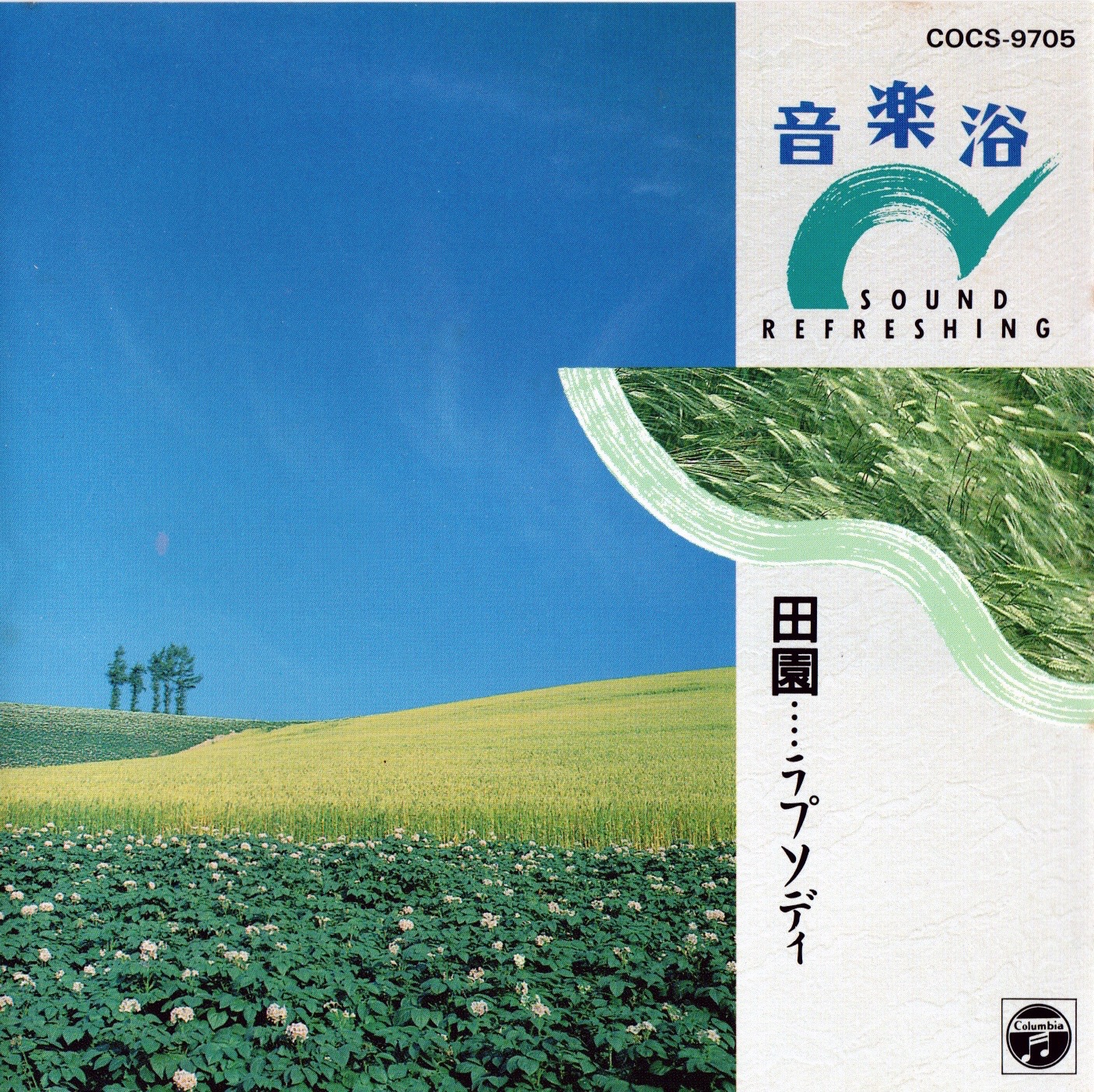
I don’t know about you, but one way I try to really understand music—or at least those behind its creation—is to dig deeper, to figure out just where its influence starts. I say this because right now, I’m listening to the late, great violinist-composer Hiroki Tamaki’s 音楽浴 田園・・・・ラプソディ (Music Bath – Countryside… Rhapsody), and with an archived copy of Tamaki-san’s site at hand, I’m sifting through a page dubbed “Forgotten Composers,” putting that idea to use trying to explain this work.
As I hear a certain strain of spiritual music—a different kind of kankyō ongaku, one floating above the void by mixing jazz, neoclassical, and minimal music—I remain hopeful that this peek into Hiroki’s influences, “where Hiroki Tamaki will introduce, with his own opinion and prejudice, the composers and their works that have been forgotten or underrated among the classical music that he has listened to for several decades since he became aware of things,” will yield something that explains this music’s pull on me.

Sussing out a few names I’ve run across before—Lou Harrison, Friedrich Nietzsche, Joseph Canteloube—I begin to understand just a bit more clearly what Hiroki’s own music is tuned to. Trying to move away from classical music, away from atonal contemporary music, toward a sort of postmodern music that still speaks to those searching for a universal foundation, I can trace how Hiroki’s life led to his “Sound Refreshing” series—to 音楽浴 田園・・・・ラプソディ (Music Bath – Countryside… Rhapsody).
Hiroki couldn’t have been born in Japan at a worse time. During the height of World War II, in 1943, his father moved the family to a mountaintop Zen temple to escape the firebombing of their native Kobe. When they returned six years later, it was first to what is now Mukō—one of the few villages to mostly survive the devastation—before finally making their way back to Kobe.
Born in Kobe, Hiroki Tamaki began composing music at the age of six and took up the violin at ten. At twelve, he gave a public performance of Mendelssohn’s Violin Concerto, and by fifteen, he had graduated top of his class from the Soai Children’s Music School’s Ear Education Department. He then entered the Osaka College of Music High School, graduating in 1962 at the top of his class and continuing to Tokyo University of the Arts to study instrumental music.
At Tokyo Geidai, Tamaki studied violin under Wilfried Hanke, former concertmaster of the Berlin Philharmonic, and joined the Tokyo Symphony Orchestra as a student performer. Yet during this time, he also developed a deep interest in composition and began to move away from classical music itself. Upon graduating in 1965, he chose composition over performance, studying under Naozumi Yamamoto for four years.
Tamaki’s composing career began with music for Tsuburaya Productions’ Operation Mystery, then expanded through his work with Nikkatsu Films, scoring titles including the Noraneko Rock series and Melody of Rebellion. He became known for collaborations with directors like Seijun Suzuki and Toshiya Fujita.
His arrangement of NHK’s Mori no Kuma-san became a national hit and launched his broadcasting career. In the early ’70s, he became a prolific commercial composer, creating over 1,500 works for clients such as Toyota and Kanebo. He also remained an active performer, playing jazz and rock violin, founding the Tamaki String Quartet, and appearing on NHK programs like Happy Concert and Untitled Concert.
In 1975, Hiroki established Vivace Co., Ltd., through which he produced concerts and recordings for artists including Kiyoshi Hasegawa and Tokiko Kato. That same year, he set aside the Tamaki String Quartet to form S.M.T., a new group exploring jazz and progressive rock. Their album Time Paradox—a weirdo gem of Japanese prog music—featured Tamaki’s electric violin leading the charge into new territory.
Just four years later, in 1979, Hiroki composed 雲井時鳥国 (Cloud Realm of the Hototogisu), a symphony for orchestra and seven analog synthesizers. This marked his entry into electronic music and established him as a key figure in early Japanese MIDI and computer music. He would go on to advise Rittor Music and develop multimedia software. But it was around this time that his interest in just intonation began to take a more spiritual turn.
As noted in the Nippon Acid Folk 1970–1980 compilation, Hiroki encountered the philosophy of Bhagwan Shree Rajneesh (aka Osho) and became deeply invested in translating its anti-dogmatic, self-actualizing ideas into sound. The result was 1980’s Bhagwan Shree Rajneesh, an album pointing to a cosmic return to natural resonance, rejecting equal temperament in favor of acoustic truth. Inspired by the likes of La Monte Young and Harry Partch, Tamaki sought music that resonated differently, that might drift toward spiritual or elemental clarity for its heft.
Listening back, Bhagwan Shree Rajneesh foreshadows the more acoustic-minded, roots-driven sound that would define his “Sound Refreshing” series. This was roots music—if you believe, like I do, that psychedelic ideas can come from a purer place, a place tied to holistic connection and the “known unknown.” Using traditional acoustic instruments to create decidedly untraditional neofolk, Tamaki offered music that gestured toward the universal.

By the mid-1990s, Tamaki was a recognized advocate for just intonation and pure-tone music. He founded the Pure Tone Music Research Institute and launched publishing ventures like Aruki Co., Ltd. His wide-ranging output—spanning orchestral works, chamber music, film scores, and musicals—cemented him as a multifaceted figure in Japanese contemporary music. Yet, some of his most generous, least understood works came from a short-lived Columbia Records project in the early ’90s.
There, Hiroki reconvened a collective he called the “Mind Messengers”—his own version of Art Blakey’s Jazz Messengers—to revitalize Japan’s New Age scene. Across six albums, this group explored relaxation music using classical instruments and just intonation. Of all those recordings, none surprised me more than the one I’m sharing today.
音楽浴 田園・・・・ラプソディ (Music Bath – Countryside… Rhapsody) possesses a grace and sophistication that never goes out of style. Featuring pianist Haruki Mino, oboist Riki Yasuhara, vibraphonist Isao Kanayama, cellist Tsunehiro Terai, and Hiroto Tamaki on violin and viola, the group glides through meditative, post-Impressionistic compositions that pull the quietest threads from jazz, chamber, and ambient music into something new and stately. For some reason, it reminds me, surprisingly enough, of Yo-Yo Ma’s ideas on Appalachia Waltz (an album that resonates with me on a similar wavelength) or Tomoyuki Hayashi & ForestIII’s The Forest. You hear it more easily than you describe it—in songs like “花ぐもり” (Blossom-Dimmed Sky) or “風だより・・・水のいのち” (Wind Tidings… Life of Water).
The music here embodies a kind of jazz that has quietly faded away—jazz focused not on feel, but on feelings. Songs like “風たちぬ” (The Wind Rises) echo the lyricism of modal jazz or pastoral neofolk. Pieces like “季節の凪ぐ宵” (A Calm Evening of the Seasons) feel like lost modal music treasures tucked inside a relaxation CD. It’s music steeped in memory, conjured by something as simple—and as profound—as the countryside.
Stripped of all sonic adornment, Music Bath – Countryside… Rhapsody never feels out of place. The world will always make room for music that uses all its contrivances to express one thing: people respond to a deep message expressed simply. As I listen to the gorgeous interplay of piano and vibraphone on “風だより・・・季節の光に” (Wind Tidings… Into the Light of the Seasons), I keep returning to the album’s recurring theme—wind tidings.
Air, after all, is how taste travels. The more time passes, the more we’re inescapably moved by the broader weather ebbing and flowing around…But yet…yet there are some works that cut through it all—rocking back and forth, flowing up, gliding down, catching the wind, making their way down slowly like a feather. Give Music Bath – Countryside… Rhapsody some time, and listen to it fall gently on your ears.
FIND/DOWNLOAD