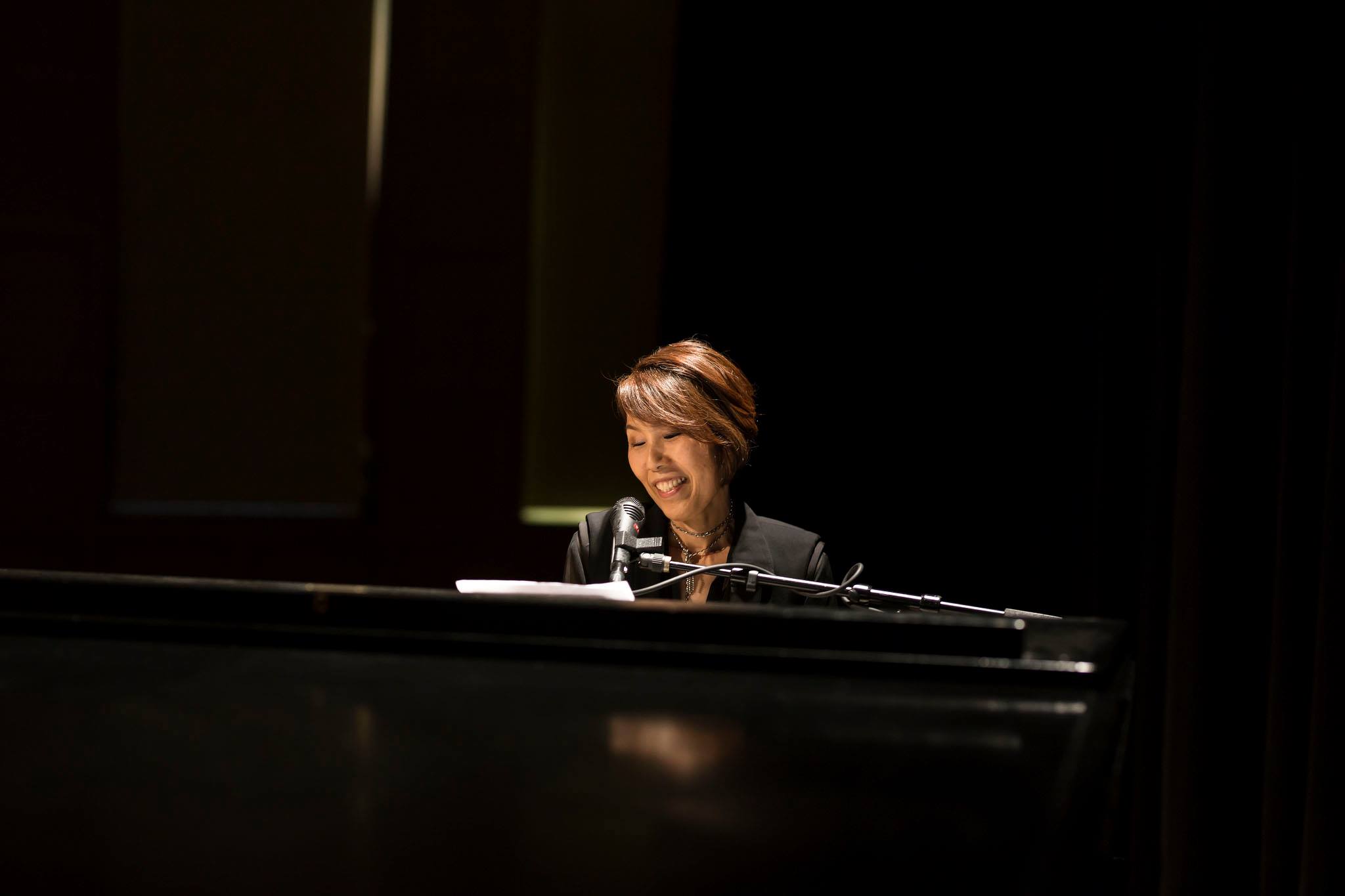
If you do whatever it is I do with this blog, every once in a while you’re bound to get that email that fills you with both dread and surprise: when the artist you wrote about reaches out. Your mind races…did they enjoy what you wrote? Did they completely disagree with your review? Or—worse yet—what if you got something wrong? Those are the little worries that linger at the back of your mind every time you hit “publish.” And yet, I keep going—because of artists like Kuniko Fukushima, who go above and beyond to help me close the circle.
A few months ago, Kuniko reached out to thank me for writing about her music and including her among the other artists I’ve highlighted on the blog. She told me she was pleasantly surprised by the level of detail I put into describing her work—something that, as you can imagine, felt like the highest praise I could receive.
In the end, aside from hearing that readers resonate with the music I’ve shared and sometimes even become champions of it themselves, nothing gives me as much joy as discovering that the artists themselves value the effort I’ve put into writing about them. And yet, it’s precisely because of their generosity that I feel compelled to ask one more thing of them: their time—to share their story.
When I first wrote about Kuniko, I felt a deep connection to the ideas expressed on her 1982 album 夢幻 (Mugen)—that sense of genre and stylistic fluidity. It’s music unafraid of its multitudes. Kuniko could move through rock, soul, tropical, meditative, and more without hesitation. The more I dug into corners of history piecing together her story, the more I felt her biography reflected a kind of perseverance. If music can speak to you, hers told of someone who understood the value of staying true to her creative convictions. That’s what pushed me to want to hear more of her own thoughts on her career.
As you’ll see in my interview with Kuniko, her life zigs as much as it zags—leading her back to Japan after many years in America. And through it all, she explains perfectly why she continues to write and perform, and why she’s unafraid to follow her own muse. For now, let’s dig a little deeper with her guiding us through.
[Editor’s Note: A million thanks to Kuniko for her time. You can find Kuniko Fukushima on Facebook and on Note.]
Kuniko Fukushima (福島邦子) Interview

Diego Olivas (F/S): Would you like to share some of your background? I believe you were born in Okayama, Japan. How long did you live there and how did such a city shape your life?
Kuniko Fukushima: I was born in Okayama Prefecture and lived there until I was 12 years old. In that small town, my father ran an electronics shop, so our home had things like a television and a stereo, which were still uncommon at the time. Adults from the neighborhood would often gather at our house to watch TV or listen to music. In that environment, I used to sing popular songs and children’s songs in front of them.
Around the age of five, my mother began sending me to piano and singing lessons. Meeting my music teacher at that time made me feel an even deeper joy in music.
Diego Olivas (F/S): What kind of music did you grow up listening to?
Kuniko Fukushima: I have two older brothers, and during their school years they formed a band. They practiced Japanese “Group Sounds” music, as well as songs by The Beatles and The Ventures. I was only five or six years old at the time, but I often listened to their music, which naturally sparked my interest in that kind of sound.
My father also played the guitar as a hobby, so I grew up hearing him play Japanese popular songs as well.
A little later, I became a big fan of American pop music, especially artists like Connie Francis and Eddie Hodges.
Diego Olivas (F/S): What sparked in you the love of music and inspired you to want to create it? And what compelled you to become a singer?
Kuniko Fukushima: Thanks to the influence of the piano teacher I met when I was little, I came to see music as something fun, and performing or singing myself became even more enjoyable. As a result, my interest in music grew deeper and deeper.
Even back then, I began to dream of having a career related to music in the future.

Diego Olivas (F/S): Can you tell us the story of how you made your major label debut? It seems you were a songwriter – writing for artists like Anri – before you released your first single with For Life Records, “グッド バイ”. How did you sign with For Life Records?
Kuniko Fukushima: I entered the 14th “Popular Song Contest” (commonly known as “Popcon”), organized by Yamaha, performing with my band and an original song I had written. We advanced through the regional and national rounds, and eventually won a prize in the final competition held at Tsumagoi. We also received awards from more than five record label sponsors. One of the main competitors for the sponsor awards at that time was “Masanori Sera & Twist,” a band representing Osaka.
My debut came about thanks to my music producer, Masami Koizumi, who encouraged me to sign with For Life Records. Back in the 1970s, Mr. Koizumi had also won a prize at Popcon and performed with his band Koizumi Masami & Kongari Toast under an exclusive Yamaha contract. Later, he became a composer and contributed songs to many artists, as well as creating numerous commercials.
Mr. Koizumi continued to support me after that—guiding my songwriting, helping shape my identity as an artist, and introducing me to many other musicians, including Anri, whom he also mentored.
I began writing songs for other artists after my debut. One of the first was Anri, which came about partly because she was also signed to For Life Records and shared the same director as I did.
Diego Olivas (F/S): Your debut showed a lot of the wonderful variety that would lead to Mugen. You could tackle soul, rock, folk, funk, pop and more with equal fervor. Were there any artists or musical ideas that inspired the musical world you were trying to create on albums like I’m Ready and To?
Kuniko Fukushima: Although I began writing songs more seriously after my debut, I had already started experimenting with songwriting during my amateur band days. I was a big fan of Carole King’s music and her singer-songwriter style, and I dreamed of becoming an artist like her someday. That inspired me to slowly start creating my own songs.
Later on, under the guidance of producer Masami Koizumi, I listened to artists like Linda Ronstadt and Boz Scaggs, whose music had a significant influence on the way I shaped my live performance style.

Diego Olivas (F/S): On records with Bay Bridge (ベイブリッジ), you’re frequently seen playing guitar and playing the role of frontwoman. Did you consider yourself a solo singer or was your preference to work in a band environment at that moment?
Kuniko Fukushima: During my amateur days, I was the keyboardist and vocalist in a band, so when it was decided that I would record, I heard that it would be a solo debut rather than a band debut. Because of that, I did feel a little sorry toward my band members.
However, they were genuinely happy and supportive of my solo debut.

Diego Olivas (F/S): Was there ever a desire by the record company to impose an image on you or market you a certain way? You were young enough that it could have been easy for them to capitalize on your looks but it seemed you had other ideas.
Kuniko Fukushima: I believe For Life Records intended to promote me as a singer-songwriter rather than focusing on a glamorous image. Personally, I was not very comfortable with being in the spotlight, so I understood and agreed with the company’s approach.
However, there was a period when my management agency temporarily hired a modeling agency for photo shoots, including styling and photography staff. I felt a bit of resistance to that direction, and in the end, we ended up reshooting the photos in a more natural style.
Diego Olivas (F/S): What kind of reception did you receive in Japan with this trailblazing work? I can’t think of many other Japanese women (or men, truth be told) who had such a diverse-sounding catalog in that period of time–feel free to correct me, of course.
Kuniko Fukushima: As a songwriter, I personally never felt any discomfort with the music I created—it all came naturally to me, and I wanted to share it with others.
However, some people criticized my work, saying that it lacked consistency and that it was unclear what direction I was aiming for.
In interviews, when asked, “What kind of music are you trying to pursue?” I would answer that I didn’t want to be confined to any particular genre, and that I simply wanted to create music that honestly reflected my own sensibilities.
Diego Olivas (F/S): Mugen marked such a dramatic departure from your earlier work—sonically, lyrically, and emotionally. What was happening in your life or mind at the time that inspired this shift in direction?
Kuniko Fukushima: It may have been a period when my motivation for songwriting and my awareness as an artist were gradually growing stronger. At the same time, I also began to feel some uncertainty about what kind of artist I should aim to become.
In the midst of this, producer Koizumi always supported me with insightful and fresh ideas, guiding me toward new possibilities.
I believe his expectation behind the collaboration with the Moonriders was for me to create something new in a world different from what I had experienced before.
I remember how inspiring it was to experience Keiichi Suzuki’s unique musical sensibility, realizing that my own songs could come alive in such a way!
Diego Olivas (F/S): You’ve collaborated with iconic figures like Tsugutoshi Goto and Jake Conception on early records and Hideki Matsutake, and the Moonriders, to name a precious few. How did those collaborations come about, and how did they influence your creative process on Mugen?
Kuniko Fukushima: The musicians for the recordings were chosen according to the intentions of producer Koizumi. For me as a songwriter, having such renowned musicians work on my songs was a very fortunate and gratifying experience. Watching their performances firsthand during the recording sessions made me truly appreciate the skill and professionalism of these artists.
As we progressed with the production of the second and third albums, by the time I created Mugen, I began to really enjoy the process of songwriting.
The themes of my songs also evolved—for example, for “あいして京城,” I imagined foreign landscapes and looked at photographs, while for “涙のTOKYOハイウェイ,” I actually went out to explore myself. I started trying various approaches to inspire and inform my songwriting.

Diego Olivas (F/S): You mentioned Keiichi Suzuki and the Moonriders’ influence on Mugen — is there a single recording session or arrangement choice from those collaborations that surprised you or changed the way you approached a song? Can you tell that story?
Kuniko Fukushima: The arrangement for “あいして京城” was also done by Keiichi Suzuki. I still remember the first time I heard the intro during the recording session—it felt so strange and intriguing in the best way. It went far beyond the sound I had originally imagined, in a way that completely surprised me—in a good sense.
When I heard the full arrangement, I remember feeling that the “Asian world” I had envisioned in the song came through even more vividly.
Also, the chorus phrase in “泣きたい気分” had such a fresh, melancholic melody line. I was really happy to experience Keiichi Suzuki’s unique musical sensibility up close. Both he and I took part in singing the chorus, and it made for a really fun recording session.
Diego Olivas (F/S): Many songs on Mugen blur genre lines—drawing from reggae, electropop, ambient, and even Caribbean influences. Were there any specific artists or records outside Japan that were inspiring you during that period?
Kuniko Fukushima: In addition to Linda Ronstadt and Boz Scaggs, whom I discovered after my debut, I also enjoyed listening to The Pretenders, Enya, The Police, and Sting.
Diego Olivas (F/S): There’s a tension in Mugen between vulnerability and experimentation. Tracks like “ひとりぼっちのラブソング” and “孤独の船” feel deeply personal and others like “あいして京城” and “夜を追いかけて” have a degree of experimentation that remind me of Grace Jones’s tropical-tinged work. Were you intentionally exploring emotional themes through new sonic textures, or did that evolve naturally in the studio?
Kuniko Fukushima: Mugen was released as a CD in 2013, compiling early recordings. The last track included, “孤独の船,” was written around 2011 and received high praise during live performances, so it was included as a bonus track on the Mugen CD.
By that time, my songwriting had shifted to focus more on the lyrics. The melodies became simpler, and rather than carefully crafted words, I wanted to honestly express words that came directly from my own emotions.
“孤独の船” is a song born from more personal feelings compared to my previous works.
Diego Olivas (F/S): Can you walk me through your typical songwriting process — do you usually start with a lyric, a melody, a chord progression, or a particular sound? Are you still writing songs now?
Kuniko Fukushima: These days, I often start writing songs with the lyrics. That doesn’t mean I write all the lyrics first—instead, words are usually the spark that inspires a song. From there, I gradually add melodies and refine the lyrics as I go.
I’m still writing music, albeit at a slow pace. Even when I’m not playing the piano, I’m always on the lookout for words—phrases that resonate with me emotionally. I try to hold onto them. It’s not something I feel I have to do; it’s more of a habit, something I do naturally and unconsciously because I always want to connect things back to songwriting.
That said, turning those scattered, puzzle-like words into a complete song takes time and can sometimes be challenging. But when the song finally comes together and I get to sing it, there’s a unique joy and sense of accomplishment that makes it all worthwhile.
Diego Olivas (F/S): Looking back, how do you feel Mugen was received at the time—by fans, your label, and peers? Did it feel risky to step outside the expectations of the more mainstream Japanese rock or pop scene?
Kuniko Fukushima: I personally never paid much attention to how my albums were evaluated, but it seems that the live support musicians and others involved in the performances found them very interesting.
As for Mugen, I believe it truly blends a variety of genres. From my own perspective, I analyze this as reflecting a constant feeling within me that cannot be confined to just one style — a mixed and diverse sensibility.
Diego Olivas (F/S): I forgot to ask about the wonderful Mugen cover design! If you still remember, can you share what was the idea behind the album cover? Where did you take the photos we see on that album?
Kuniko Fukushima: The cover photo for Mugen was taken by photographer Jin Tamura. He’s well known for photographing Miyuki Nakajima, among others. In addition to Mugen, Tamura-san also worked on the cover photos for several of my other releases.
Mugen was actually shot at the fifth station of Mt. Fuji, around dawn. Surrounded by a dreamlike, mystical landscape, we captured the photos in that magical moment. Tamura-san never shot in studios—he always preferred natural light and outdoor locations. I really liked his style, and because of that, I felt I could approach the shoot without feeling too self-conscious or stiff.
This Mugen photo shoot remains one of the most memorable for me.
Diego Olivas (F/S): Your musical journey reflects a constant search for authenticity, even in the face of industry pressures. What helped you stay true to your artistic vision, especially as a woman leading a band in a male-dominated rock scene?
Kuniko Fukushima: At that time, I wasn’t sure whether I myself was positioned within the rock scene. In the industry, artists like Kumiko Yamashita and Takako Shirai were emerging one after another in the rock scene, and there were occasional joint concerts. Looking back now, I think the industry provided a better environment where each record company nurtured these female artists individually.
Perhaps that supportive environment was a source of strength for me as well.
Diego Olivas (F/S): After releasing La, La, La and moving to America, you stepped away from the spotlight. Was that time spent away something you needed creatively or personally—or both? What brought you to America?
Kuniko Fukushima: After La, La, La, my contract with For Life Records ended and I became a free agent.
It was a period when I had distanced myself from music, and I think I was uncertain about what I should do next.
With La, La, La, I was able to record in LA and spent an inspiring time working with American musicians.
At the same time, I was captivated by New York during a free visit and later experienced living there for three months. During the time I had been away from music, old musical friends reached out to me, and I gradually started performing live again.
At that time, I thought I would never go to America again, but due to a certain opportunity, I ended up marrying a Japanese man and moving to Seattle.
Diego Olivas (F/S): Does any part of you still miss that “rock n roll” lifestyle? What is the main thing that sticks with you about that time under the spotlight?
Kuniko Fukushima: There was a time when people associated me with a strong rock image, especially because of my style of singing while playing electric guitar. And honestly, performing on stage like that was a lot of fun.
At the same time, though, I also felt a certain pressure—like I had to deliver a great performance every time.
Years after I left For Life, I had the chance to do a live show focused purely on rock, together with some of my old bandmates. Picking up the electric guitar again after so long and singing with everything I had—I truly felt, from the bottom of my heart, just how fun it is to play in a band.
Diego Olivas (F/S): Now that you’re back to performing and teaching in the U.S. and Japan, how do you approach music differently than you did in the 1980s? Has your relationship with your voice or songwriting changed?
Kuniko Fukushima: Since moving to the United States, the biggest change for me has been that I became more conscious of Japan than before — of the Japanese language and of myself as a Japanese person.
I also developed a renewed interest in Japanese children’s songs and old popular songs.
When it comes to songwriting, I became more aware of the importance of using clear, relatable Japanese — words that truly reflect who I am.
Diego Olivas (F/S): How have your ties to Japan changed now that you spend most of your time in America?
Kuniko Fukushima: I have lived in the United States for 11 years, but actually, this fall I will be moving my base back to Japan.
While in Seattle, I held three solo concerts, and the audiences who came enjoyed and embraced my Japanese songs. I truly felt the openness and generosity of American music culture and its acceptance of different cultures.
I love this relaxed atmosphere in America, where you don’t have to force yourself to be someone you’re not.
Even after returning to Japan, I will maintain my connection with the U.S., so I plan to visit America occasionally.
Diego Olivas (F/S): As a teacher now, what are the one or two lessons or exercises you most enjoy giving students, and how has teaching affected the way you think about your own performances and songwriting now?
Kuniko Fukushima: Currently, I hold small classes with just a few people in Seattle and in Japan. Rather than “teaching” in a formal sense, I simply share what advice I can based on my own experiences.
In those sessions, I focus especially on helping them express lyrics naturally and exploring the groove that comes from putting words to music.
These days, I feel that I’m the one being inspired by them.
Diego Olivas (F/S): “孤独の船” and other songs feel very personal — when you perform those songs live today, if you do, do you reinterpret them differently than the studio versions? If so, how do you decide what to change?
Kuniko Fukushima: “孤独の船” is a song I wrote quite some time after becoming independent. Around that time, I began to place more importance on lyrics, and my melodies also became simpler and more stripped-down.
Even when I perform this song live, I keep it very close to the studio version. In live performances, I focus on the vocals and use a minimal arrangement without layering too many sounds. I believe that this allows listeners to feel the depth of the song more clearly.

Diego Olivas (F/S): What brought you back to Japan, if you don’t mind me asking?
Kuniko Fukushima: My 11 years living in Seattle were incredibly meaningful, filled with valuable experiences and many wonderful encounters. I was also able to hold three solo concerts there, which was a big milestone for me. Singing in front of a large audience—including many Japanese people living in Seattle—was truly a precious experience.
Later, during the COVID-19 pandemic, when I found myself staying home for extended periods, I began to reflect on whether I should remain in the U.S. or return to Japan.
In the end, I realized that I wanted to go back to Japan and continue my musical journey there. I came to feel that continuing music in a foreign country, in the long run, would be difficult for me. I understood that Japan—where there’s no language barrier and I can sing in a more relaxed environment—is where I truly belong as an artist.
Diego Olivas (F/S): Many younger listeners are discovering your earlier albums—are you interested in remastering or reissuing any more of your records, or perhaps curating a special archive release with demos, live tracks, or more that we haven’t heard? Has anyone approached you about this?
Kuniko Fukushima: Right now, there are no specific plans, but playing sessions with the current members feels really comfortable, and I feel they help bring out and deepen the world of my songs.
If possible, I’d love to create something together with them in the future.

Diego Olivas (F/S): Many of your new fans are rediscovering your early albums and recognizing them as ahead of their time. How does it feel to see a new generation embrace music that once flew under the radar?
Kuniko Fukushima: The music from the era when I was mainly active never feels outdated to me, even now. It carries a warmth that comes from being made by human hands.
I feel very fortunate to have been a part of that scene.
Looking ahead, I believe we live in an age where music can be created more freely and flexibly than ever before.
However, I also think that people will continue to seek the human touch in music — the healing and warmth that can be felt through words.
I hope to create music that embodies those qualities as well.