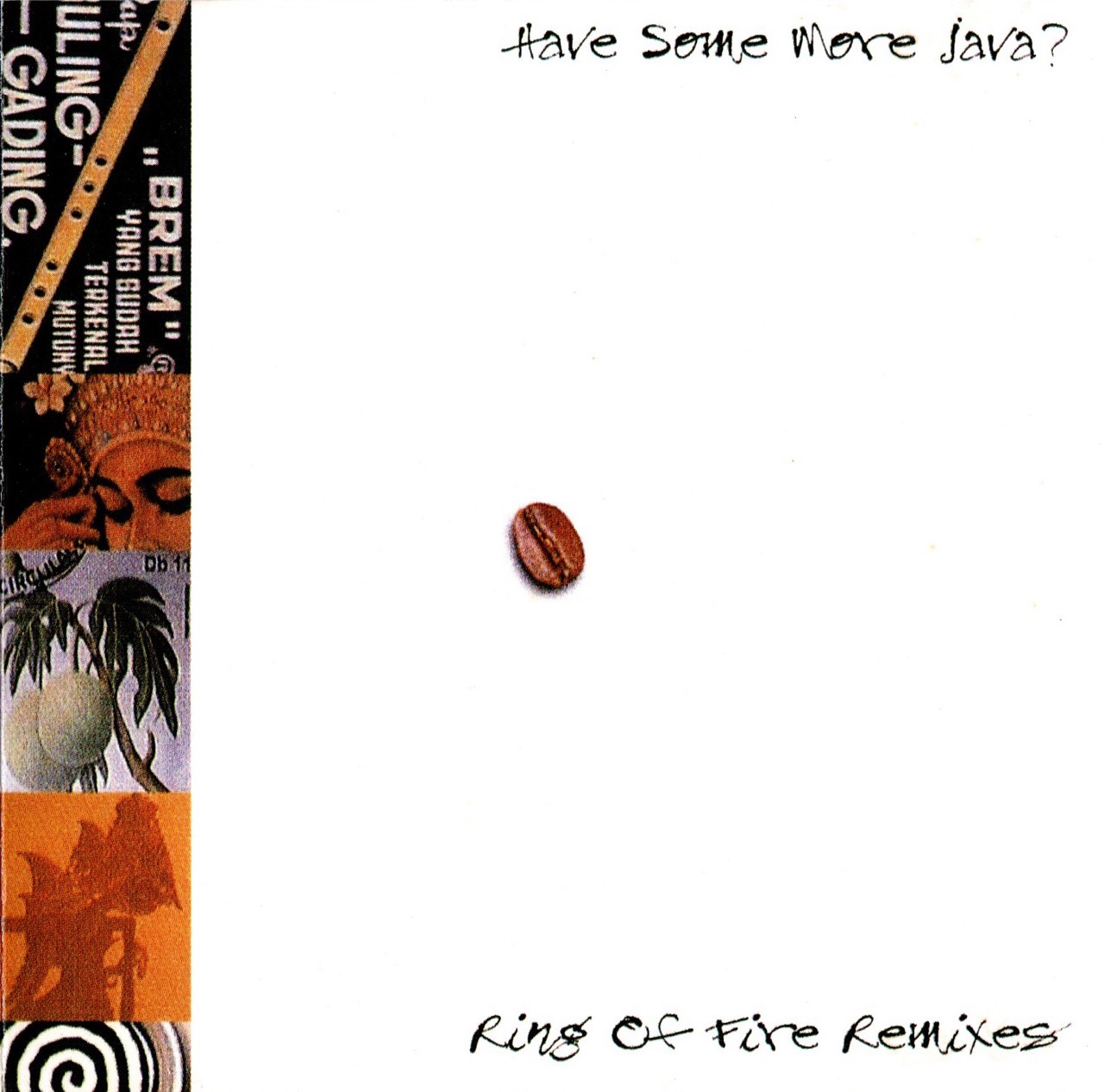
What’s the sign of a great remix? For me, it’s that the cover version sets the spirit of the original onto a different journey, coaxing out alternate visions that draw water from the same well. When I listen to Kensuke Shiina’s Have Some More Java? (Ring Of Fire Remixes), I’m reminded that all it takes is one great sound source.
Kensuke Shiina is no stranger to the art of remixing. A native of Yokohama, Kensuke grew up in a family where you worked to earn what you wanted. And for a young Kensuke, that meant developing a DIY ethos — fashioning or creating radios, sound machines, and gadgets he couldn’t afford from a department store. An early love of prog rock transitioned into punk until Kensuke discovered funk and soul and became an early adopter of “rare grooves,” scoping out Japanese record stores for hidden rhythmic gems.

In the early ’80s, as he gained knowledge of music production, working on radio shows like the pioneering freeform Snakeman Show and album spurred Kensuke to think less about adhering to any genre, and more about creating music with no set boundaries. By the mid-’80s, his deep and growing knowledge of all sorts of music — spanning a wide range of genres — led him to be hired as a freelance music selector and writer, curating leftfield sounds heard on mainstream radio shows, dramas, and fashion runways.
At the start of the next decade, Kensuke’s curation found him crossing the border from writing liner notes for cutting-edge records — touching on styles from the Caribbean and Southeast Asia — to actually becoming a musician himself. He joined Yann Tomita’s “Audio Science Laboratory,” putting his electronic tinkering skills to work creating fantastic instruments to play new-school exotica.
Eventually, Kensuke would man the boards, producing for Indonesian singers like Sabah Habas Mustapha and Japanese hip-hop artists Gas Boys, who took advantage of his impressive production and sampling skills. Meanwhile, in Europe, he caught the ears of England’s Pussyfoot Records, who were building a roster focused on trip-hop and downtempo music. In 1995, the first release under his name, “Insomniac,” for the label, proved just how different his idea of downtempo was. On it, you hear him combine Indonesian gamelan music with roots dub, creating a mix of mysterious, mystical-sounding, ephemeral dance music.
It would be two years later, in 1997, when Kensuke finally released his follow-up, “Ring Of Fire.” Seemingly inspired by the many lands connected via the literal Ring of Fire in the Pacific Ocean — from Polynesia (south of the Equator) through Southeast Asia, Japan, the North American West Coast, and down through Central America to the Altiplano and Cape Horn of South America — it was a six-minute-long, dubbed-out techno track that drew a circle around all his musical influences, connecting them sonically. And for those in the know, this track was a barn burner, slotted into many a DJ’s 12-inch crate.

What’s impressive about Have Some More Java? (Ring Of Fire Remixes) is how the compilation promotes Kensuke’s vision of borderless music. Released later that same year on his Emigration Japan label — a label he started to promote homegrown house and techno — Kensuke provided stems of the track to other artists as a tabula rasa, allowing them to express different resonances from it — and from himself.
This is something you hear on Kensuke’s own “Beyond The Java Sea,” a floating, meditative rework that uses the original’s iconic flute to transcend into the realm where trip-hop and devotional music can coexist. Jiro Yoshizawa (aka Arrow Tour) takes the “Ring of Fire” to the fourth world with “Never Been To Bali,” an evocative, atmospheric track that hovers between darkness and mystery. The duo Salon Kitty use the original to express a spacey lounge version, while Hiroshi Mizuno (aka Animo Computer) approaches it as a broken beat — taking it apart and putting it back together with the twinkle of a cheap demo song that somehow bumps.
Others, like Kaoru Inoue (aka Chari Chari), use their time with the original to draw out its percussive elements, balancing drum and bass with deep-groove jazz. Fellow Emigration Records co-founder Manabu Nagayama, as Mad Vibes, takes the idea of each remixer striking a different blend figuratively, creating a remix that lands with a decidedly “French Touch” — filtering the song through a soft, cosmopolitan feel.
The album begins to wind down with Kensuke’s aforementioned “Beyond The Java Sea,” a stunning Walearic track reimagining a Pacific State farther from the sea, closer to the jungles of Borneo. This darkness feeds into the metaphorical “Dark Light Of Essence” that the trio Natural Essence resonate with — creating a haunting track that weaves in ethereal, melismatic chant and Kraftwerk’s “Europe Endless” to highlight the otherworldly innards of the original–a seemingly endless Pacific coastline.

It’s the original track, in all its glory, that capstones the record — bringing you back to the not-so-faint echo coursing throughout the compilation, influencing all those involved. In these times, when we all could use a bit of a pick-me-up, this impressive collection of like-minded but free-spirited creators vibing to the same ingredient sounds just perfect to these ears.