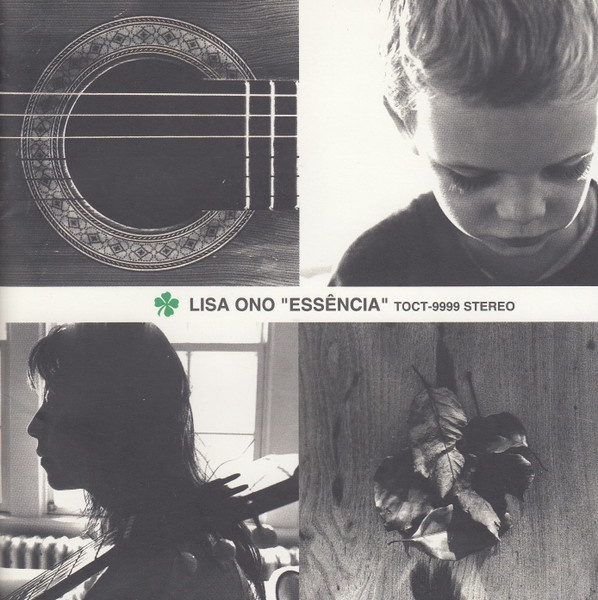
If you’re like me, you notice a world often starving for a little peace and quiet. As I scan what’s popular out there, I feel heartened to see how singers like Laufey, Beabadoobee, and Ichiko Aoba are able to feed the real need for a different kind of pop artist for a newer generation. I say all of this because, as I listen to Lisa Ono’s Essencia, I’m reminded of just how much one can accomplish (and what audiences one can resonate with) by simply owning where one comes from and what one loves.
For those in the know, Lisa Ono’s status in Japanese music is unimpeachable. Through her performances and recordings, she’s put on record a long-lasting bridge to the Brazilian nation Japan has been connected to for over a century.

Born Risa Ono in São Paulo, Brazil, in 1962, Lisa was part of the second generation Japanese diaspora that tried to make a living in Brazil. It was her parents who set off there to pursue their dreams of starting a music venue where the Brazilian artists they listened to on imported LPs could perform.
For ten years, Lisa was raised in a household where Brazilian and Japanese words and music intertwined. In her father’s club, Ichibani, famous Brazilian artists like Walter Wanderley and visiting Japanese singers like Kyu Sakamoto would perform—feeding an early appreciation for all this music floating in the air. By the time her parents decided to return to Japan to open one of its first Brazilian restaurants, Lisa had internalized and blended all these influences within herself.
It was her family’s Saci-Pererê restaurant in Tokyo that became the de facto convergence point for all things Brazilian-Japanese. Whether you were part of the Brazilian diaspora working in local factories or diplomatic missions craving a taste of home, or a Japanese patron looking to experience Brazilian culture for the first time, the Ono family created a welcoming place to explore a world previously known only from afar.
As successful as the restaurant became, little did Lisa’s parents know that her feelings for Brazil remained strong—and only deepened as she grew up in Japan. Before she sang, Lisa would collect whatever Brazilian LPs she could find and listen to them at home. It was in Brazilian music that Lisa found her connection to the language she didn’t want to leave behind. The transformation into Lisa Ono the singer began when she picked up her first guitar.
At the age of 10, Lisa practiced classic Brazilian numbers while other children took to rock and pop songs. What began as an inspired pastime at home—and brief performances for relatives—eventually made its way to her father’s restaurant, where she was often coaxed into singing on stage. Patrons who were surprised to hear a Japanese singer perform samba would be even more impressed when she played the delicate songs she understood as bossa nova. Seeing the power she had to command an audience with her “quiet” songs, Lisa realized that this was the music she was meant to pursue.
Before she was signed to a record label, Lisa struggled to find her audience. Was she a jazz singer? Did she belong in cafés or folk clubs? Commercial offers came in for this “Japanese bossa nova writer,” and she worked as a session musician for artists like Taeko Onuki—but as a solo singer, it seemed there was no space in the Japanese music industry for a homegrown bossa nova artist.
When record labels began courting her, several offered deals on the condition that she abandon Portuguese singing. It took three long years before someone finally gave her the freedom to sing exactly how she wanted. Her 1989 debut, Catupiry, caught fire almost by chance—coinciding with the rise of new, barista-centered coffee shops that were replacing the old kissaten, where jazz and cigarette smoke once reigned supreme.
Finding that space allowed Lisa—through regular TV and stage performances—to become an ambassador for modern Japanese-Brazilian music. In the early ’90s, albums like Nanã and Menina caught the attention of both Brazilian and Japanese listeners, earning her recognition in critical jazz awards and year-end lists. By the time Essencia arrived in 1997, Lisa’s blend of bossa nova originals and covers had led her to work with legends like Tom Jobim, Sivuca, and João Donato, and to live her dream of dividing her time between Brazil and Japan.

The reason I’ve zeroed in on Essencia, and hope you do as well, is because I think it gives you perhaps the best gateway into what Lisa was able to exude—and how a certain feeling, that feeling of saudade, of pining for something can materialize anywhere.
While other albums give you a window into the warmth and immediacy of Lisa Ono’s vision, few reveal this more ruminative, meditative side of her. Influenced by the bittersweet Brazilian strain from Minas Gerais, her work in New York City with one of its greats, Toninho Horta, brought her far from the chic sounds of Rio and closer to the barefoot sound he helped create on timeless albums like Clube da Esquina, or in his collaborations with Lô Borges, Joyce, and Milton Nascimento.
A who’s who of session musicians—Yoichi Murata, Pat Metheny Group members Mark Egan and Danny Gottlieb, and the incomparable Randy Brecker—contributed spacious, lived-in arrangements that allowed Essencia to exist outside of time. Songs like Tom Jobim’s “The Red Blouse” positively beam with beauty. Others, like the title track (an original), carry a mysterious air reminiscent of Edu Lobo or Nara Leão. Covers of Milton Nascimento’s “Beijo Partido” and “Travessia” gain a new, hidden expression through Lisa’s voice. Even her and Toninho’s take on The Beatles’ “Across the Universe” recalls a time when a few young musicians from Minas were reimagining foreign influences in their own way.
In the end, I appreciate that Lisa didn’t have to go this route so deep into her career—yet she found a way to dig deeper, uncovering new gradients in the primary colors that first inspired her to be herself. I could go on: Toninho’s “Waiting for Angela” and “Tardes na Tailândia” sound even more wonderful with Lisa’s vocals gracing their new arrangements. Even old standards like Charlie Chaplin’s “Smile” take on an easygoing character that fits the album’s moody warmth. Lyricist Ana Terra helped Lisa craft two of the album’s most plaintive ballads, and on “Me Nina,” Lisa stands at the forefront—guitar in hand—guiding us through some of her most yearning songwriting.
Lisa Ono probably doesn’t need anyone like me to write her story—Japanese music history has already given her a special place—but in my story, I keep returning to how enjoyable and accessible this album stands out in her discography. This has to be your introduction to her world.

Better known in Japan for its single “シ・ア・ワ・セ” (“Shiawase”), this song closes the record by finding a way to vocalize in her native language something she once struggled to express in her love language through Essencia. It poses a quiet question: how does one convey something that strikes at your feelings in a way that can’t quite be quantified? Shiawase—happiness—in the end, has its own gradients that take time to appreciate. In loud times, it’s those moments of quiet and stillness that hold a special gravity in our universe. Someone better than I put it simpler: “Quiet nights of quiet stars, Quiet chords from my guitar, Floating on the silence that surrounds us”.