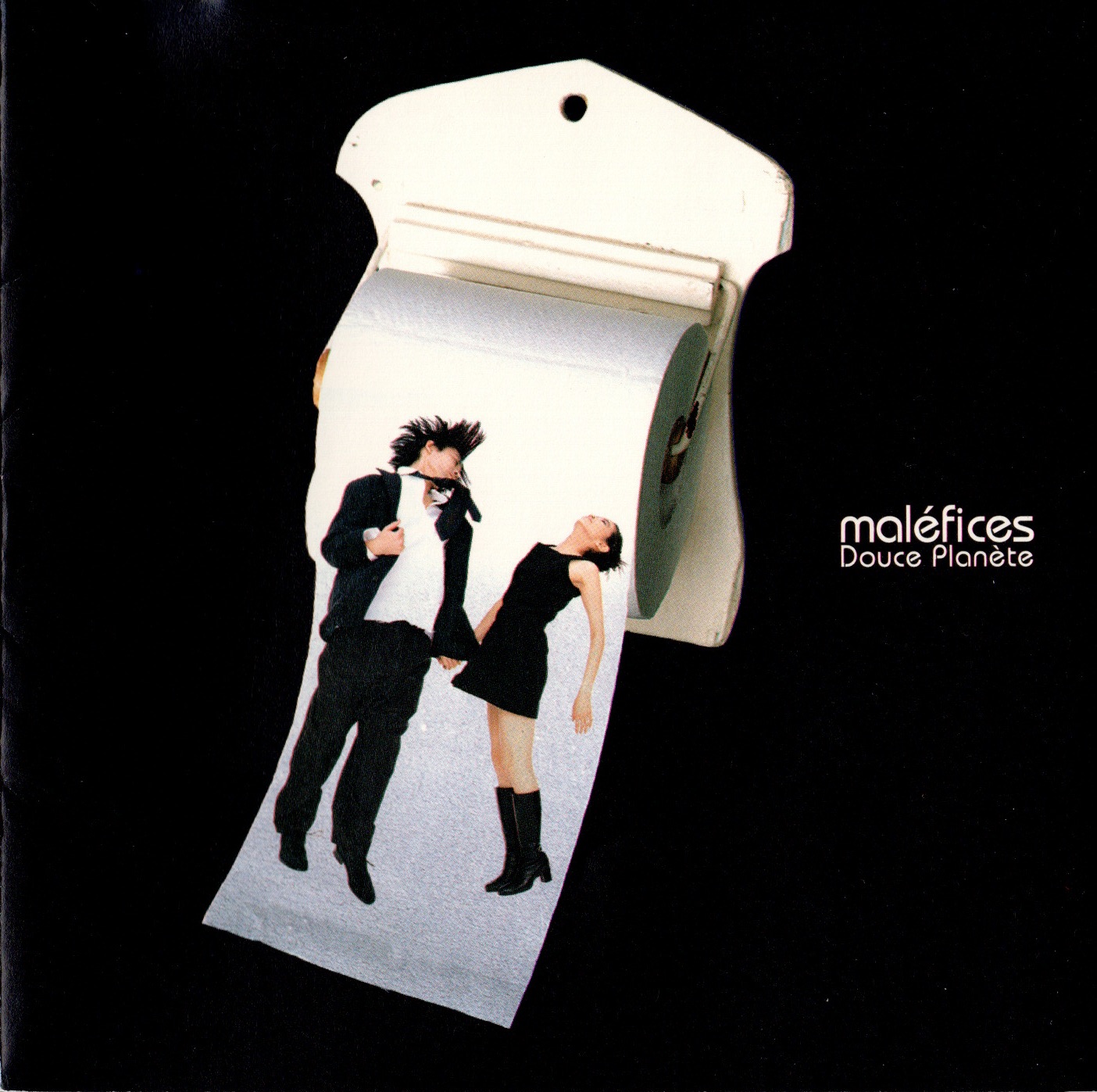
A frequent question I get is this: How do you discover music? The simple answer is: I’m all ears. I say this because I wouldn’t be writing about today’s group, Maléfices, and today’s album, their Douce Planete, if it hadn’t been for Kyle (proud owner of NYC Chinatown–based record store Paradise of Replica) reaching out to share something that might resonate with me. In a way, it’s similar small acts of kindness that feed into the reason I wanted to pass along their story and his recommendation to the broader world.
I once wrote in the liner notes to French duo Uman’s Chaleur Humaine how “history, both private and public, is scattered with creative relationships between siblings that simply did not work.” I did so trying to hammer home this point: what brings us together emotionally or physically might not exactly translate into – or facilitate – what we can do together creatively. In my humble opinion, close relationships have been torn apart by that immense, assertive thing called “ego,” coming between people who would otherwise be close in myriad ways.

When I wrote this treatise then, in the back of my head, I thought of how rare and difficult it must be to find such a connection with whoever you call your significant other.
Looking back, I can understand why the Japanese duo of Lune Kitakami and Taku Kamoshita, aka Maléfices, might have called it quits after their first and last full-length album, 1996’s Douce Planète. I can imagine that the existence of their relationship was too important to risk by chasing a dream that wasn’t turning out as intended. Too far ahead of their time, and simply put, too “foreign” in their ideas, their run of good fortune had, in effect, run out in this part of their relationship.
Both Lune and Taku were the products of impressive fate. Born in 1970 in Tokyo, Lune was the youngest daughter of a Japanese poet who married and had children quite late in life. A mercurial character, he’d taken his family to Paris to escape the conformity of Japanese culture and raised them on the outskirts of the city. When her father returned in 1976, during her formative years, Lune was enrolled for a decade in Tokyo’s Lycée Franco-Japonais as a way for him to keep alive the dream of instilling in her the French language and culture that had taken root during their brief stay abroad. By the time she was a teenager, she had inherited her father’s love of poetry and had begun to write her first French songs.
Taku would wind up following a similar trajectory. Born in 1969 in Tokyo, he came from a cosmopolitan family whose line of work took them around the world. From the ages of six through nine, Cairo was home. Then, at ten, his family moved to Paris for three years. By the time he returned to Tokyo to graduate from a prestigious Catholic high school, Taku understood he was different. Those early, formative years had changed him. They were where he discovered the music of Africa and tapped into the world of Wes Montgomery and jazz, picking up his first guitar at fourteen.

In hindsight, if you look at the point in their lives where the two would come together, it would be France. It was 1986 when Taku returned to Paris to pursue a bachelor’s degree in French. Just a year later, Lune would make the same trip, enrolling at the Sorbonne to pursue her own degree in the language. Paris would be where they met and fell in love, moving in together in a small flat in Neuilly-sur-Seine.
Their ease of writing in French led to a shared love for French music. Artists who might have sounded foreign to others – Jacques Brel, Art Mengo, Brigitte Fontaine, to name a precious few – were ingrained influences that inspired their first demos together. Although they were of Japanese descent, their music was tied deeply elsewhere, whether to the Francophone chanson tradition or to more global inspirations, even when written with French, English, or Japanese lyrics.

After graduating from their respective universities in 1993, Lune and Taku dropped out of their master’s programs to pursue a more slippery dream – modern chanson music for contemporary Japanese audiences. It was this ambition that drove them back to Japan, where they shopped their demos to various labels before one, Victor, signed them, completing one of their pipe dreams.
Unwavering in their conviction to chanson, they adopted the name Maléfices, perhaps in homage to Henri Decoin’s mysterious thriller Maléfices, helmed by that giant of French chanson, Juliette Gréco. Rather than debut with a full-length record, they stuck to the EP format, centering their mini-albums on six tracks united by a single “worldview.” As vocalist and lyricist, Lune spun imaginative songs unafraid to leap between her known languages, while Taku, as multi-instrumentalist, created impressive arrangements more worldly in nature – developing a newer, cosmopolitan, Walearic vision of “Japanese” music.
Their lead single “Granada,” off their mini-album debut, 1995’s Deux Demis, brought into full scope just how panoramic their musical vision was. Sung in pitch-perfect French, Lune sang of waiting for the love of her life in Andalucia, of rekindling a romance, to music that oscillated between the influences of Latin America and Africa, between dance music and bittersweet, ethereal, sophisticated pop. A striking song to this day, it still sounds like little else out there.
Deux Demis was recorded in Victor’s own studio with the help of musicians like Yasuhiro “Coba” Kobayashi, Akira Inoue, Mataro Misawa, and Yasuharu Nakanishi, who understood their assignment to give Taku’s electro-acoustic arrangements that extra oomph. For a first attempt at distilling what Maléfices was about, songs like “Deep Breathing,” their stab at a Japanese-language song, come across as refreshing takes on what could have been a different direction for Japanese pop. Others, like “Gasoline,” sung in English, recall groups like Everything But The Girl or artists like Anna Domino, who combined disparate strains of jazz and pop in serpentine ways.

Such is the purview of youth that later that same year, on their follow-up mini-album Les Clandestins, they were able to take a more mature direction, enlisting artists like Vagabond Suzuki and Pecker, and taking the helm as producers to focus on a more rhythmic and less ethereal sound. Funky and soulful, it presented another side of what Maléfices could be.
The first single from the album, “Sachet De Safran,” returned to the nouveau French electropop that inspired their earliest recordings. What impresses now, though, are songs like “Une Rencontre Au Départ,” which mutate tango into their form of sophisticated pop. Other tracks like “La Merveille” conjure a different take on dream pop. Personal favorites like “低気圧” pointed in a new direction inspired by R&B and urban music, slinking with a meditativeness that fit them perfectly. The bossa nova of “Maladie D’amour” and its contemporary, darker reimagining, “Les Ailes Du Désir,” glide effortlessly through their creative sphere, finding new corners to pull ideas from.
Whether this album or their debut were meant to function as hors d’oeuvre, they were fitting appetizers for what would become their main course, their masterpiece.

Douce Planète, released a year later, presented an even further departure from their past. Using the French language less as an exotic flourish, they hoped to express its malleability, with “each song on the album represent[ing] a country, and their collective existence form[ing] a single star” – in essence saying: this is how far we can take our native tongue. Playing a form of cosmic chanson, songs like lead single “Millions D’Ions” transported their music through the sounds of the Maghreb, introducing Lune to melismatic phrasing that remains utterly inspiring. Absconding from a large studio, they settled into a smaller one closer to Tokyo’s hustle and bustle, hoping to feed off the city’s vibe.
Their “gentle planet” of music allowed them to create eleven celestial tracks, each orbiting a single, radiant center. Album opener “Retrouvailles” explodes the spirit first expressed in “Granada” onto the altiplano, mixing explosive Japanese-tinged samba with something like Congolese electro-rumba. If you felt Maléfices always had a hidden undercurrent perfect for the dancefloor, Douce Planète plays like their attempt to make everything more joyful and moving.
Imagine the slinky, baggy electro-funk of “Répondeur” existing in an earlier version of Maléfices. This is Maléfices understanding where music was going and feeling free to explore the future. Even their kiss-off to French pop – their cover of Serge Gainsbourg’s “Yesterday, Yes A Day” – hews closer to what others like POiSON GiRL FRiEND, Nadège, and others were trying to achieve, retrofitting the Gallic retro with modern accouterments.
On a record where Lune shines as a vocalist, one would be remiss not to give Taku his flowers. It’s his coming into his own that allows instrumental songs like “The Lost World” to capture a vibe that’s part Mark Knopfler and part The Orb. In this long-form format, Maléfices had a certain sprawl that made the uproarious can-can of “Au Clair du Soleil” feel like part of the same solar system as the wistful avant–J-soul of “さまようくじら.” Even little asides like “Au Café Maléfices” nod to the early exotic excursions of their Gainsbourgian inspirations.
When I hear the strains of trip-hop coursing through “Hurly-Burly,” I get taken elsewhere. I imagine a world where we get to listen to whatever fascinating musical idea Lune and Taku might have conceived next. I imagine that the magnificent album closer, “Wish You Love,” wouldn’t feel like an epic buildup to their final crescendo.
You see, nowadays, there’s a lot I imagine about their music, about their lives. I imagine they could live on a planet where what music they made found the audience they richly deserved.

Friends speak of Maléfices leaving the music industry quietly after the failure of Douce Planète absconding “[to] a maisonette with a garden, making the most of their fluent French” – perhaps much happier in their adopted homeland, oblivious to how far their music had touched the hearts of others so far away. Once again, I imagine a wrinkle in time allowing them to know their time to move forward is still now.