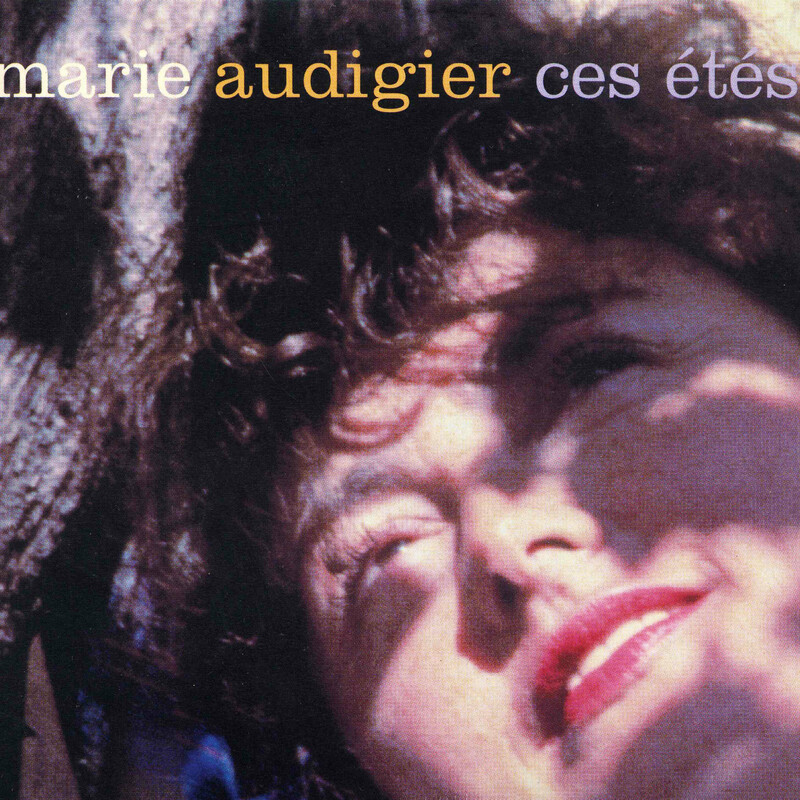
If there’s something about autumn, it’s that when it truly settles in, it triggers some kind of musical Pavlovian response in me — a need to dig through the back catalogs of a few well-worn labels that I know just exude an autumnal feel. Whether it’s something tucked away on England’s Cherry Red or Sarah Records, or on Belgium’s Les Disques du Crépuscule, there’s always something interesting to revisit or discover in their rosters that fits this season so well. And today, I thought: Why not pick something brilliant hidden beneath the record pile? Why not shine a light on Marie Audigier’s Ces Étés?
Ces Étés was the second and final album by French singer-songwriter Marie Audigier. Featuring sparkly yet bittersweet songs like the title track and its lead single, “Paroles en l’Air,” Ces Étés is imbued with the feeling of looking back at a long-gone summer — cozying up to nostalgic memories felt or experienced in her native French countryside.

Marie Audigier was born and raised in Clermont-Ferrand, a city surrounded by mountains whose closest “big city” neighbor was Lyon — where Les Disques du Crépuscule would host one of their scene-defining Crépuscule Nights. Before being discovered and signed by that label, Marie was in a close personal relationship with French singer Jean-Louis Murat, serving as his sounding board for musical ideas and occasionally contributing to his records. Over time, it was her gift for composing thematically strong yet delicate songs that opened doors for her to create her own music.
Her 1991 eponymous debut EP introduced Marie’s singular sensibility — one influenced by jazz and the music of The Pale Fountains — into the realm of the solo singer-songwriter (aided, of course, by her more famous partner, Murat). Songs like “Un Voyage” hit those perfect notes of wistful folk rock, dialing down the rough edges of twee pop–adjacent groups like The Pastels and Velocity Girl — contemporaries who, for lack of a better word, lack Marie’s graceful, easygoing, distinctly French touch. Her cover of “Dream a Little Dream of Me,” reimagined as “Rêve un Peu à Moi,” cements her earnest charm, cutting through any trace of pretension.

Marie’s 1993, full-length follow-up, Ces Étés, was recorded in just 20 days at Studio du Faubourg in Aix-en-Provence. She described it as an “album of lost childhood.” Its songs evoke simpler times: “Saint-Sauves, near La Bourboule, getting out of the car on the Sancy plateau, swimming in the Sioule — bathing in the nostalgia of a happiness that fades away.”
For six long weeks before the recording, Marie rehearsed her songs, preparing for the chance to perform and record them live with a full band. Members of New Order and from both Factory and Les Disques du Crépuscule were at one point supposed to collaborate on the album. In the end, though, working with Jean-Louis Murat’s backing band and session musicians felt more natural. Seeking independence, she kept Murat at arm’s length this time, intent on asserting her own vision.
The record earns its distinctly autumnal tone through the spectacularly ambivalent chords of guitarist Denis Clavaizolle, which feed the luminous atmosphere of songs like “Nuits Agitées” and “La Fontaine.” Marie’s lyricism and vocals grow leaps and bounds on her homage to The Pale Fountains, “Le Grillon.”
In the end, in a world of cut-and-paste French chanteuses, Marie’s strident vocal range powers gorgeous, sepia-toned stunners like “Si Bien” and “L’Amertume.” The latter, especially, embodies the bittersweetness that gives the record its impressionistic shimmer — landing softly on the improvisatory spirit of nocturnal jazz and setting her ideas apart from the pack. The intimate romanticism of “Paroles en l’Air” speaks to that same ambivalence woven throughout this music.
Years and decades have passed. Marie has moved on to other more important things. Yet this music still lingers, carrying with it a scent — of cinnamon, evergreen, and bergamot — a fragrance that hasn’t lost its intoxicating power so many seasons later.