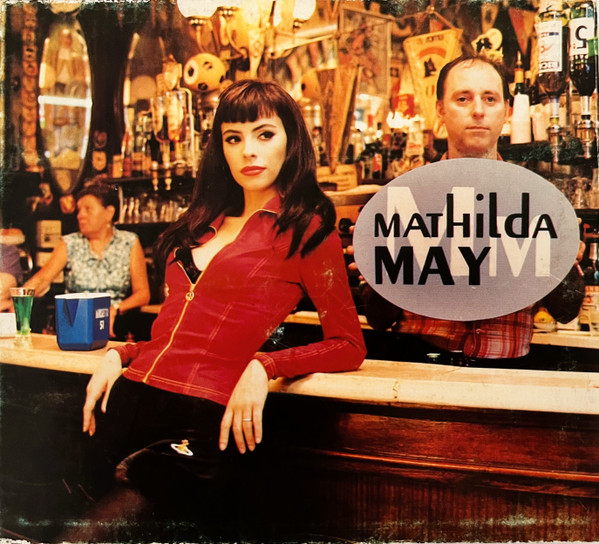
We’ve all got to have a bit of grace with ourselves sometimes. Lately, I’ve realized that one thing I miss is sharing music that might be even more outside anyone’s wheelhouse. In the past, I did this by splitting two blog posts a week — one focused on Japanese music, and another that was more freeform, unbound by genre or locale. As I dialed back to posting almost exclusively about Japanese music, I found myself missing that part of the process that let me freestyle a little, even if it’s a bit more straightforward and succinct. I say this because life’s too short to miss out on music like Mathilda May’s self-titled 1992 debut.
Far from an unknown figure in the French-speaking world, Mathilda May — much like Isabelle Adjani — has long graced stage and screen as an actress of note. Appearing in various states of undress in films like Naked Tango and Lifeforce, she truly made her mark on global audiences with her role as Jacky in the 1997 American action thriller The Jackal.

Born in Paris to a Swedish mother and a father of Egyptian and Turkish descent — the former a dancer and choreographer, the latter an actor — May was originally given the name Karin Haïm, a name she hated. Eventually, she convinced her parents to let her change it to Mathilde. Her earliest dream wasn’t to follow in her father’s footsteps, but rather her mother’s, pursuing the stage at the Paris Opera. That dream led her to study at the prestigious Académie Royale de Danse and, later, to win prizes at the Conservatoire de Paris.
It was only luck — or chance — that opened the door to acting. Her first role came almost on a whim, a dare from her agent to try something different. Auditioning for a part that called for “a blonde who speaks English,” she landed the role in Claude Nedjar’s Nemo despite being neither blonde nor fluent in English. Unlike other French actresses of the era — often blonde and coquettish — Mathilda stood out for being brunette, blunt, dark, and raw…not your father’s ennui or your mother’s ingenue. By the late ’80s, she was outpacing many of her more studied peers by fully inhabiting whatever role she took on.

What makes her woefully out of print, 1992 self-titled debut so impressive is how much her music carries the same conviction that defined her other creative work.
Throughout her career, Mathilda zagged where other French actresses zigged. When labels reached out to sign her, she continuously refused their offers because of the strings attached. She could sing in French. She could let others write her songs. She could hand over control to producers. But she couldn’t. Her music had to be her own, through and through.
So in 1992, inspired by funk, downtempo, and R&B, she set out to release music that could stand on its own. Signing with Columbia, she insisted on one condition: she would be a singer-songwriter with full creative control. She would not trade her fame for that. Singing in English, she created an album of sophisticated pop and soul that channeled her own neo–Rickie Lee Jones-isms into something slipperier and more elusive.
Songs like the single “If You Miss…” or “Around the World” recall the wake of the UK funky and soul movement carried by groups like Soul II Soul and singers like Mica Paris. On “Souvenir,” May touches on something closer to the Minneapolis sound, while “Do You Want Me” evokes the boho scene before swerving into a wholly different kind of sensuality.
The album nearly disappeared from view as soon as it was released. No one quite knew what to make of a record with such floating roots back then in the places it was released. Yet now, listening to songs like “Make Me Smile,” “Je Suis à Toi,” and “Joy of Love,” I hear something uniquely endearing: music that still sticks in your mind and sounds better suited for our time. It reminds me why it’s important to separate Mathilda from what she’s most known for. To remember where she came from, even with this brief reintroduction. In the end, Mathilda was always a dancer.