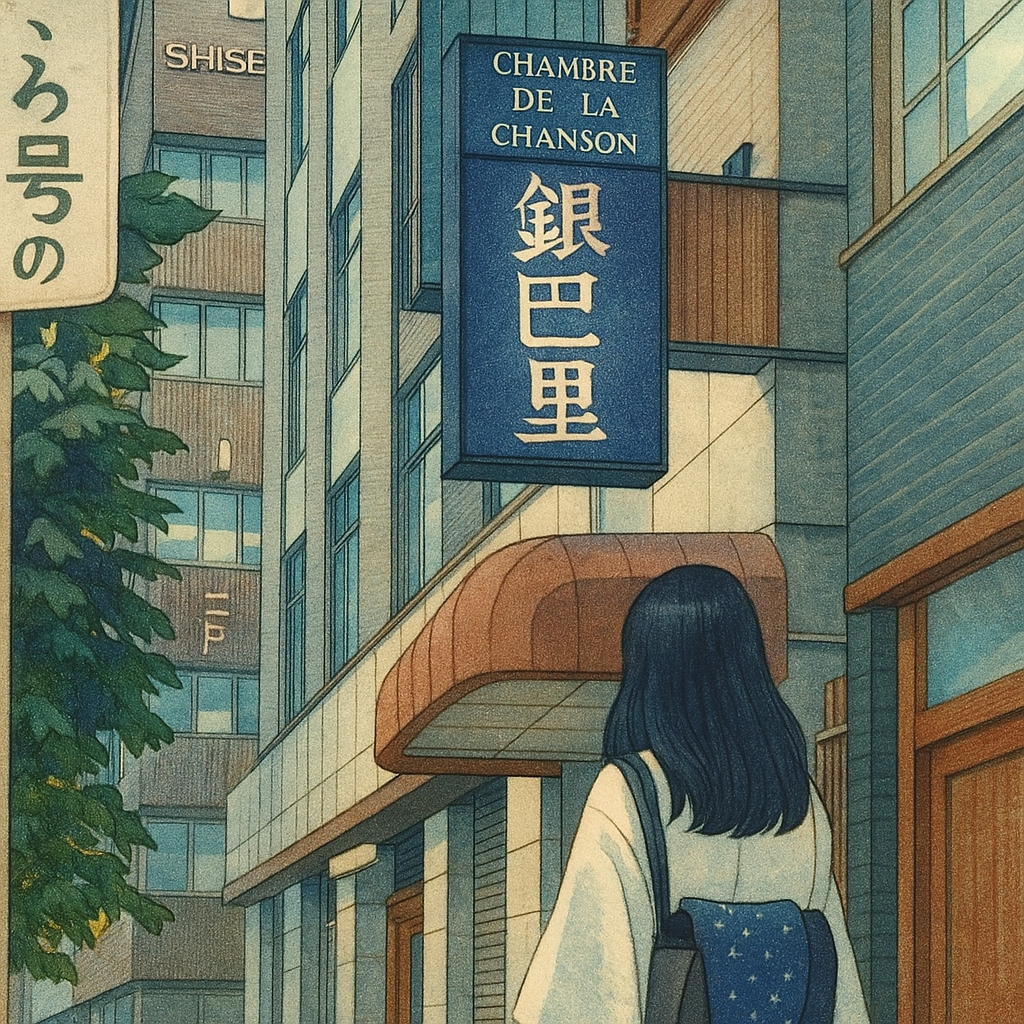
Has it really been seven years? It was back in 2018 when Lucas from LYL Radio reached out and asked me to join the LYL roster. At the time, I set aside hosting opportunities from far more known outlets because I was searching for an answer to a kind of mystery — something that broadcasting on LYL alone could provide. It was, in a way, a quest to answer this question: “Why France?” That question continues to inform my latest mix, which opens a new season of me Digging Deep.
For my first LYL Radio mix, I explored one aspect of something I often invite others to ponder through my blog: the idea of liminal culture. The notion that we can absorb influence without boundaries — that cultural exchange can exist more freely, more fluidly, as our taste develops and evolves. That’s what drove me to create a mix titled Pari Shōkōgun, centered on Japanese music inspired by French pop.

As an American of Mexican descent, this project gave me a parallel path to analyze my own influences — to ask myself: “Why Japan?” It’s an answer that I still find elusive. Yet within Japanese music, I’ve often felt a cultural kinship to find such an answer, that resonates deeply with me. It’s what led me to imagine why, within the Japanese music I love, certain artists might feel a similar kinship toward another country — one that outsiders might not expect.
If I could extend this already too-long post further, I’d tease out how, before World War II, Japan — and the Western fascination with it through Japonisme — influenced French impressionist art, art nouveau, and fashion. I’d explain how, until 1964, Japanese citizens weren’t permitted to travel abroad for leisure, which made experiencing European goods, culture, and life the ultimate status symbol. It’s from that idealized vision of Paris that Paris Syndrome — the shock of its reality — later emerged.
In postwar Japan, under American occupation, the sound of Japanese music began to shift, shaped by influential cabaret nightclubs like Ginza’s Ginpari. These venues became the launching point for Japanese chanson, or shanson, as pioneering singers like Akihiro Miwa and Yukari Kaneko revived prewar French-inspired songs and translated them into Japanese, creating something uniquely local in the process. In a way, they were echoing an earlier cultural loop — when French artists like Madeleine Fujita (born Lequeux) came to Japan to sing chansons written by Japanese songwriters.
In the end, I could go on endlessly tracing how Japanese culture — and its music, in particular — is woven through with threads of France by digging deep through its recent history. I could attempt to write a history for it that is still not written for it in some other language.
Yet, for now, I’ll do something more important. I’ll let the music pick up where I leave off. I’ll let you consider this an amuse-bouche: a small taste of where “Japanese shanson” went in the ’90s, tying back to ripples in history by artists like Madeleine Lequeux and then Yukari Kaneko. Hopefully, we’ll tug at those other phantom threads later.
Nihon No Shanson (日本のシャンソン)
Tracklist:
Maléfices (マレフィス ) – Granada
Hirono Nishiyama (西山豊乃) – L’Été
Tomoyo Harada (原田知世) – T’en Va Pas
Yumiko Okayasu (岡安由美子) – パリの中国人
Chiharu Iwamoto (岩本千春) – かがみ
Les 5-4-3-2-1 – Je T’aime
Mari Natsuki (夏木マリ) – マリア・マリ
Kumiko Takahashi (高橋久美子) – どうぶつの国
Celia Paul (シリアポール) – Under the Jakaranda
Isako Saneyoshi (さねよしいさ子) – イエナ
Mayumi Itoh (伊東真由美) – 無言の告白
Ryoko Moriyama (森山良子) – セ フィニ~愛の幕ぎれ~
Naomi Chiaki (ちあきなおみ) – 赤と黒のブルース
Yuriko Nakamura (中村由利子) – ウィスパリング・アイズ (Whispering Eyes)
Yukari Kaneko (金子由香利) – 聞かせてよ愛の言葉を