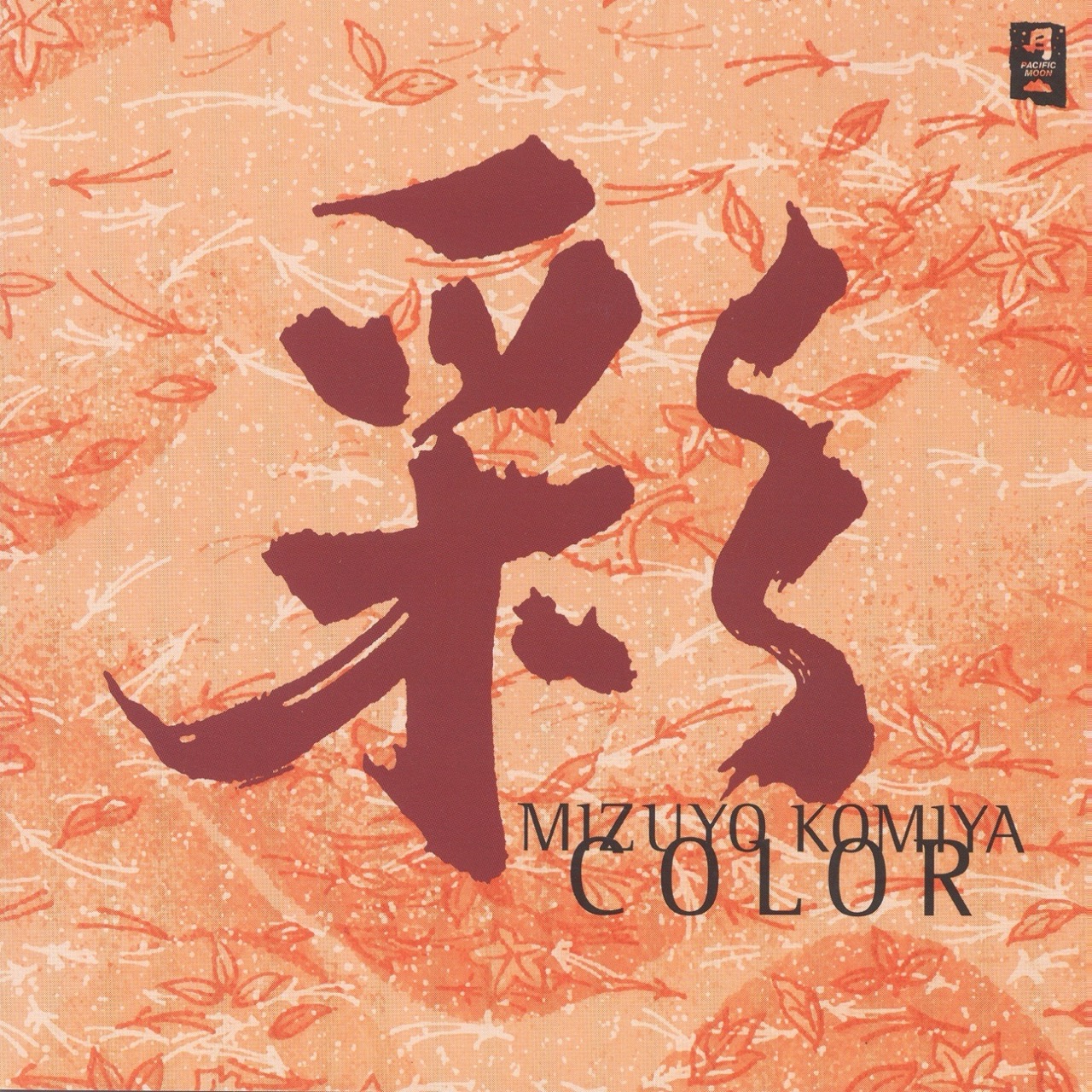
There are times when I wish I had a way to share everything that comes with an album. Just by looking at online entries for Mizuyo Komiya’s Color (彩), you wouldn’t know what you’re missing by not owning a physical copy. Tucked between the CD tray is a space where a pack of incense sticks once sat. Created by master incense makers from Kyoto, once lit, it adds another olfactory dimension to Mizuyo’s exploratory music. It’s not that the album’s music is diminished without it, but that this music, when paired with other senses, can conjure up a different, heightened experience.
Perhaps that’s why I think Mizuyo Komiya’s Color (彩) makes a perfect entryway into the world of Pacific Moon. Albums like this one embody what that Japanese label aims to achieve with their releases: “a smooth blending of the ancient meditative sounds of the Orient, with the universality of modern music of the West.” One might not have personally experienced the cultural significance of lighting such incense and hearing such music, but one can tap into a shared universality by “harmonizing [with] the two.”

Released in 1998, Color (彩) marked Mizuyo Komiya’s debut as a recording musician. Born into a family of Tokyo koto players – with a mother like pioneering musician Keiko Nosaka, who helped expand the 13-string koto to 20 and 25 strings, and a father, Minoru Miki, who was integral in modernizing the koto’s repertoire – Mizuyo had no shortage of guidance. Yet early on, she found her own direction.
As soon as she was old enough, Mizuyo said goodbye to Japan and set her sights on America, where she studied at Boston’s Berklee College of Music and eventually, as noted in the original liner notes, moved over to the New England Conservatory to major in Contemporary Improvisation. There she absorbed other modalities in jazz, folk, and contemporary music. By the time she returned to Japan in the ’90s, she wasn’t interested in making koto music in the traditional sense.
Color (彩) is something of a return to the experimental, evolutionary nature of Japan’s most recognizable instrument (itself a transplant of Chinese and Korean origins). Taking advantage of the fuller octave range of her 25-string koto, she split the album metaphorically in two. The first half explores her instrument in concert with modern instrumentation and contemporary musicality. The second half translates and transposes shakuhachi compositions – specifically from Katsutoshi Nagasawa’s famous “To Nishikigi – 5 Showpieces,” originally inspired by nature – into solo koto, pieces originally performed by her mother many moons ago.
One doesn’t have to look far back to find influences in Mizuyo’s music. Records by her mother, like 1983’s ニライカナイ Requiem 1945, which blended New Age, prog rock, and koto, proved how expansive this instrument could be. On Color (彩), the opening half finds Mizuyo working with ambient composer F.A.B. (aka Seiichi Kyoda) to craft her own floating music.

Songs like the opener, “Tsugaru Overture,” drift slowly through spacey, atmospheric sonics, only to open fully with Mizuyo’s probing melodic sensibility. Her interpretation of her father’s pre-classical-inspired “Mebae” sounds both ancient and contemporary. Another interpretation, Yukiko Ishii’s “Sea Wind,” draws out the piece’s quietly ruminative quality. Songs like “Spring Rain” and “Akatombo” – the former an original by F.A.B. and the latter a reimagining of Kosaku Yamada’s childhood standard, better known as “Red Dragonfly” – become quiet, powerful, improvisatory works meant to fill silent spaces rather than drown your world in sound. “Tsugaru Wave” ends the first half with another impressive reinterpretation, accentuating its quiet moments with even more esoteric koto passages.
The album then floats into its latter half with instrumental pieces for solo koto. Songs like “Aidama” and “Moegi” take those shakuhachi showpieces and transform them into flights of fancy across Mizuyo’s strings. Color (彩), much like other Pacific Moon releases I hope to get to, isn’t a record you put on to dance yourself to the cutting edge of music. Rather, it has a unique charm that works best as a kind of palette cleanser.
Songs like “Ruri” command your attention by easing you into Mizuyo’s world – when you do, in fact, choose to pay attention. “Kohaku” carries you through dramatic peaks and valleys, but only if you follow its lead. Album closer “Nakisuna” lets the silence between notes deliver the heaviest waves.

In the end, much like appreciating incense drifting through the air, you lose much of the experience if you don’t appreciate the ember’s glow, the mercurial shape of the smoke, and the simplicity of the practice itself. In many ways, at first listen, Mizuyo Komiya’s Color (彩) might appear simple, but simply put, it’s quite powerful when it drafts itself into the space around your air…but you have to give yourself that allowance – of time and space – to let it float down.