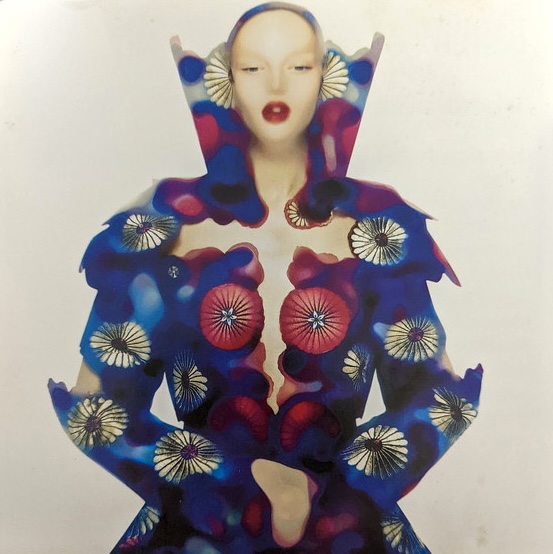
Music and fashion have long been interconnected. Musical subcultures have been defined by certain fashions, pop and rock stars become style icons with ease, and catwalks are synonymous with soundtracks as models strut their stuff.
Radical Fashion, a compilation released in 2001, doesn’t fit into any of the above. Indeed, the only strutting you can imagine with this release is the slow walking in and out of gallery rooms. That’s because it was commissioned alongside a book by Claire Wilcox to accompany an exhibition of the same name at London’s Victoria and Albert Museum (V&A), the world’s largest museum of applied and decorative arts.
This show from the turn of the century spotlighted fashion designers such as Alexander McQueen, Rei Kawakubo, Vivienne Westwood, Junya Watanabe, Jean-Paul Gaultier, Yohji Yamamoto, Hussein Chalayan, and Issey Miyake. Opening a few weeks after the events of 9/11, reviewers at the time saw the happening as a world away from current events, an enclave of dreamlike designs of display (with zero models strutting, as Radical Fashion was a pure exhibition rather than a fashion show).

I argue the dreamlike atmosphere was likely reinforced by the soundtrack of each space in the gallery. Musician and sound curator David Toop was enlisted to map out Radical Fashion’s sonic environment, with sounds that shifted subtly to suit the character of each display.
Those sounds were produced by the artists on this compilation, with a catwalk of ambient artists: Ryuichi Sakamoto, Yoshihiro Hanno, Paul Schütze, Yukihiro Watanabe, Ensemble, Ken Ikeda, and Toop himself. Together they create probably what you imagine an ambient score to such a design exhibition would sound like, especially, if you’re already familiar with their works. And as a Fond/Sound reader, you probably are.

Sakamoto’s track, “Clouds”, is probably the only one you’re aware of; it was later retitled “Radical Fashion” and included on his Comica release a year later. I’d dare say it’s one of a few tracks that have since been re-release or seen streaming, as almost everything here was composed exclusively for the show and could only be heard on the CD sold at the V&A’s gift shop almost twenty-five years ago, never re-released since.
Like the exhibition itself, there were a lot of Japanese creatives such as Sakamoto involved in Radical Fashion’s album creation, resulting in an overall kankyō ongaku sound, or environmental music.
The Japanese influence creeps into the compositions from European composers, for example the Christophe Charles opener “Undirected/Narita”, which is named after a city in Japan’s Chiba region.
This synthetic and ephemeral track is then followed by more organic sounds, with tracks by Akira Rabelais and Hanno showcasing a most delicate piano and violin respectively, while Watanabe’s almost a cappella contribution showcases the only vocals on this album.
UK trio Ensemble contribute “Ephemere”, a beguiling instrumental following in the steps of their vocal-led debut Sketch Proposals, which was released a year before the anthology on the influential Rephlex label. In a way the piece serves as a bridge between Ensemble’s past and present, with their next album in 2006 being entirely in the same ambient, wordless vein.
Sound sculptor Max Eastley introduces a darker tone through “Cave of Mirrors”, which appears to have been likely used for the exhibition’s entrance area, and described by reviewers as a dim, cavernous black space soundtracked by equally disconcerting music. (Disclaimer: the “Radical Fashion” event happened in my youth so I have no personal experience of the show itself).
Toop and Schütze continue with similar oppressive vibes, while Sakamoto’s rising pitch of a track appears in between theirs to add a little vertigo to the V&A collection.
What strikes me the most about the compilation is how current it sounds. While today we are used to ambient film scores alongside ambient reissues from Japan, it would have been a different story back in 2001.
For a mainstream unfamiliar with Toop’s sonic explorations during the 1990s, this kind of minimalism in the UK would have been defined by Glass, Eno, import CDs, and obscure late-night shows on the BBC classical platform, Radio 3 (shout out to the long-gone Mixing It). If anything, electronic music of that era was defined more by the IDM of Warp and Rephlex than what one hears here. Either way, it’s likely V&A visitors would have expected something synth-ey and new wave adjacent, perhaps even acid techno to soundtrack a show all about fashion.
Think about 180 Studios, the contemporary London art venue often associated with record label record maker The Vinyl Factory. This type of space has hosted art installations in recent years by Japanese sound artist Ryoji Ikeda; and if you visited such an event, you’d probably half expect to walk out with a 12-inch composed by Ikeda themself.

To even have a soundtracked exhibition must have felt like new territory in 2001, and for a major British institution to celebrate both avant-garde fashion and sounds in an immersive environment stills appears groundbreaking. Radical Fashion, the show and soundtrack, were ahead of their time in that regard if you stop to consider the immersive multimedia shows happening in any major city today.
In other words, Radical Fashion was radical indeed, and while to our ears this soundtrack may seem normal today, it would have been something very alien to the guests strutting their stuff, ambling across the large expanse of the V&A.
These cold and minimalist sounds would have filled the venue, almost like lasers spanning each room to capture its dimensions and then bounce off the walls, not distracting visitors from the various arty garments but filling it with enough presence to set the scene, like a vision that only appears on the periphery.
After all, isn’t what’s fashionable today something that starts off unnoticed and on first-glance seems strange? Radical Fashion remains a reminder of a timeless allegory: never judge a book by its cover.
[Editor’s note: You can find Giacomo on Discogs.]