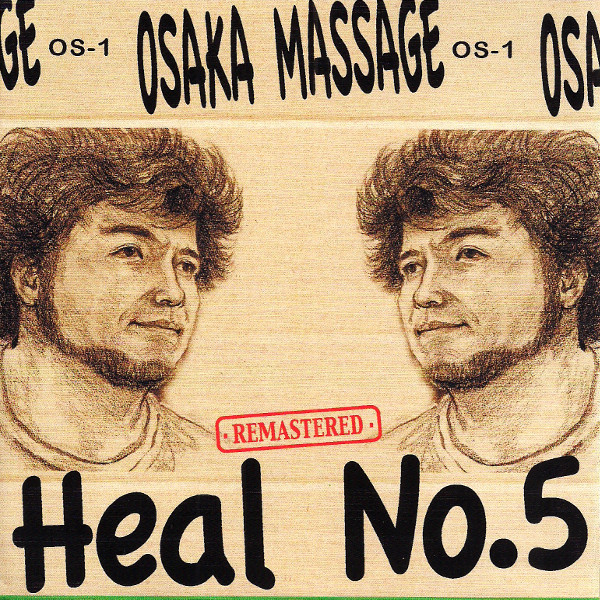
For someone like me, whose whole site is dedicated to writing about works in the past tense, there’s something especially poignant about choosing to write not just about music, but about people whose lives already are in that tense. With July 6th right around the corner, my keyboard keeps leading me back to the work of Takayuki Kihara, aka Woodman, who passed away suddenly from a heart attack in Osaka nearly a decade ago, in 2016—leaving us far too soon, with only his music left behind to help us try to understand his story.
The album I’ve chosen to highlight from Woodman’s brief but intense period of creation is Osaka Massage – Heal No. 5, an album that captures Takayuki’s attempt to bridge the gap between the Osaka dance scene and Detroit techno, all while deconstructing the myriad influences that shaped his love of dub and deep house. Devoid of liner notes or production dates, only the track titles offer clues to what Woodman was aiming for—in this case, a kind of “Rare Breezz” of living room house music.

Original CD-R releases from this series were wrapped in aluminum foil or cardboard, self-released by the artist from within the (sadly) now-gone Misono Building—a longtime mainstay of Osaka’s club culture. They were sold after live shows or left in small batches at places like Tokyo’s storied Los Apson? record store or a few Osaka CD shops. The second release of four issued while he was still alive, my copy of Osaka Massage – Heal No. 5 was procured as a lone CD-R repress in a slim case, barely surviving, sandwiched between racks in the “techno” section of Osaka’s Newtone Records. Earlier more experimental music releases were privately dubbed cassette-to-cassette in the late ‘90s but the meat of his best work was here, barely hanging on by a plastic thread. In the end, sometimes I think it’s a wonder I even got the chance to hear Woodman’s music at all.
It took a certain gumption for this Tokyo-born artist to travel twice to Detroit, Michigan, in search of the source of his musical love—only to realize that Osaka held much of that same character and rearrange his ideas. Moving to Osaka would crystallize his connection to the music he wanted to make under various aliases, culminating in his most memorable work as Woodman.
In personal notes, Woodman reflected on his time in Detroit:
I got to see DJs spinning their own tracks live at DEMF (Detroit Electronic Music Festival) and at after parties. I also had chances to visit the artists’ homes, studios, and offices—even share meals with them. Through that musical and cultural experience, what struck me most was: electronic dance music is like ohayashi—traditional Japanese festival music. Percussive and melodic like a festival’s ensemble, but also deeply atmospheric.
The late Toru Takemitsu once talked about ‘distant sounds’—tones carried on the wind. I thought: let’s make music like that, encompassing both the sounds and the surrounding environment. That’s how I recorded EAST TO EAST.
From there, I began to think of my tracks as ‘lost grooves,’ a concept tied to ‘the ghetto’ as a lost environment. I tried to relate this idea in my own words through ongoing experimentation. At times it felt a bit too conceptual, but playing live helped bring clarity.
Woodman would return to Osaka from Detroit, diving deeply into Edo-period literature and folk culture, drawing parallels between DJing, house music, and communal Japanese art forms.
Early collaborations with Osaka-based producer Takashi Yamaga (ALTZ) led to a realization: the only way to release music that truly spoke to his vision was to take full control of both production and distribution. Early releases under his own name and label focused on imagined soundtracks for places like “coffee shops” and “steak houses”—vignettes inspired directly by his life in Osaka. This laid the foundation for “Fancy Recordings”, which would later house this series under one of Takayuki/Woodman’s monikers, Osaka Massage.

In the notes for Heal No. 5, Woodman writes:
This release opens with an introductory track that marks the beginning of my exploration into deconstructing reggae through an electro-production lens. What follows is a calm explosion of the project’s essence—living room house—that defines Osaka Massage.
The tracks themselves had been shelved since the summer of 2003, and it was around that time I started to understand the QY70’s built-in ‘Create Continuous’ function—this quirky little tool.
As a result, I began intentionally deviating from standard equal-tempered tuning, using synths to push more toward sound effects and textures, all within the QY70.
You can really feel that same upgrade in energy and approach as on the Sayonara Party album 1st Cut.
Listening to the album, this distinctly floating, sometimes heavy, slightly gritty, but always esoteric music seems to be powered by the desire to express everything possible through something as “simple” as Yamaha’s battery-powered portable workstation, the QY70. One can imagine Takayuki pushing its functions to their limits, remixing tracks or grooves on the fly, as one mood melts into another. The result is a distillation of that mysterious, mercurial quality Woodman had—finding a groove, nurturing it, then letting it dissolve into an abstract ambient atmosphere and letting that zig-zag elsewhere.
Originally released on Woodman’s Housing Development label, the album is, for the few who heard it, the culmination of that early 2000s period between 2001 and 2006—before he returned to Tokyo to get married and start a family, effectively bringing this chapter to a close.
But for now, while his memory remains vivid through his music, we can revisit and explore the unique world of Woodman—one beat, one texture, one groove at a time, keeping that groove continuously moving.