The funny thing about sharing your own thoughts — about having your own site, about trying to give space for those who need it — is that there are certain limits you face. The biggest is that weight of responsibility. In this day and age, when all sorts of search engines and AI bots are scouring the web for information — perhaps your information — I’d never like to be the source of any disinformation. It’s a problem any documentarian or historian is bound to run into: where are we graceful to ourselves, and dignify the history of others, by placing our shovel down and digging no further? To simply present what we have.
To present — in this case — Ripening Japanese Esthetic Sense, a new place where Yuki Takao’s story can continue at this moment in time.

If you can place your mind back a few years, I’d like you to go back to September 2, 2022, when I first wrote about Yuki Takao’s Water Labyrinth. Back then, with the great help of Victor Hsu Jui-Ting, who was kind enough to share that album (and also Ripening Japanese Esthetic Sense) with us, we reflected on how albums like these serve as reminders of how ephemeral what we discover online can be.
It’s that unbelievable journey that starts with the artists themselves — convincing themselves that this is the music they want to release — and finding a way to make it happen, whether financially, creatively, or holistically. It’s someone giving their time and money to buy that creation. It’s someone finding worth in that music and becoming an advocate for it. It’s another person having the humility to receive that recommendation and spinning that virtuous circle again for others. It’s how music or art that could be lost to history stays alive. In the end, if one link of that journey is weak, the whole chain stands to lose its connection.
I say this because the original YouTube video hosted by Quantum Foam Sounds that held Water Labyrinth no longer exists. And if, for some reason, I had never shared a copy on my site, who knows who — or when — someone else would get a chance to listen to Yuki’s work, if ever. History remains as tenuous as I first wrote about.
It gives me solace that, although what I’m going to share today might not reveal all mysteries, it might keep the conversation rolling — and going importantly, keeping Yuki Takao’s music in our memory while expanding what we can know of her.

Ripening Japanese Esthetic Sense helps clear up a few things I couldn’t quite pinpoint before. Now we can assert with certainty that Yuki Takao was a young female composer from Kobe — not an alias for Yuki Saito. A musical wunderkind, Yuki performed and created all sorts of music for background video and audio media, focusing on bridging the gap between electronic and acoustic instruments before she even went to college.
Upon her graduation from Tokyo’s International Christian University, Yuki broadened her musical influences in earnest, focusing her studies on “sound giving life to a space as it ought to be.” In essence, she set out to become a New Age musician — creating music as sonic landscape, crafted with both electronic and traditional instrumentation.

What sets Ripening Japanese Esthetic Sense apart from her debut is how she chose to flesh out her new ideas. On this album, Yuki drew direct inspiration from the “Japanese sense of harmony and identification with nature,” as the original liner notes state. Grounding herself in this “esthetic” concept, she enlisted the help of fellow composers Miwa Inaba (13- and 22-string koto) and Keisuke Doi (shakuhachi and shinobue) to bring a natural timbre to the album’s compositions.

Unlike Yuki, both Miwa and Keisuke came to New Age music from different backgrounds, though they were around her age. Miwa, gifted from an early age, performed Japanese classical music on the koto from age four before exploring jazz and contemporary genres in college. Keisuke grew up in a household filled with traditional music until he picked up a guitar and fell under the influence of Western sounds; when he returned to the shakuhachi, it was to rekindle a connection with his first instrument.
As part of the Yuki Takao Group, the goal of expressing “contemporary Japan” with “classic Japanese musical techniques” never comes across as a self-imposed veneration of the past, but rather as a loose framework for creating a different kind of relaxation music — inspired by many styles. Such is the beauty of youth.
Throughout the album, Japanese concepts of communing with nature like sansui (landscape painting) and teien (designed gardens), references to cultural touchstones like koto (ancient capitals), sakura (cherry blossoms), and shiki (seasonal change), and traditional arts like Tanabata (the summer star festival) and noh (slow, masked, poetic drama) are paired with music that carries the hidden depth of these simple words.
As a nod to her debut — or perhaps a closing of the circle — the album opens with the plaintive “SANSUI – The Water Labyrinth,” reimagining the title track from that first record with new electro-acoustic tones and hues. It takes the leitmotif somewhere else entirely, giving it a more lived-in, spectral quality aided by her collaborators. In a group setting — at least on this record — Yuki’s wonderfully meditative sound design becomes the perfect atmosphere for each piece.
On “Teien,” what begins as a traditionally minded composition blossoms into high New Age drama, reminiscent of Mark Isham’s best work — seamlessly blending the gravity of Japanese classical music with the expansive soundcraft possible on contemporary instruments. Stark pieces like “Koto” (composed and arranged by Keisuke) transform what might have been a traditional study into something else entirely — a different kind of jazz.
With tracks stretching beyond the five-minute mark, Ripening Japanese Esthetic Sense gives everyone involved the room to occupy space — both in the stereo field and in the composition — letting the quiet moments breathe and the louder ones blend just so. You hear it in “Sakura,” where piano, koto, and shinobue form a minimal piece that slowly flows into improvisation. The starry-eyed feeling of “Tanabata” is captured perfectly in Keisuke’s moving instrumental ambient ballad, its simple melody cycling with heart through the same instruments they’ve nurtured since youth.
The album winds down with another Yuki Takao composition, “Shiki – At The Iridescent Market,” and Miwa’s sole contribution, “Noh – Midare.” In the former, electronic percussion marks the passage of time with a slippery tempo, while piano and koto seesaw through delicate modal phrases that settle gently on the ear. In the latter, Miwa’s “traditional” instrument awakens the album — miniature crescendos of koto strumming intertwine with esoteric electronics, culminating in a flurry of natural simplicity.

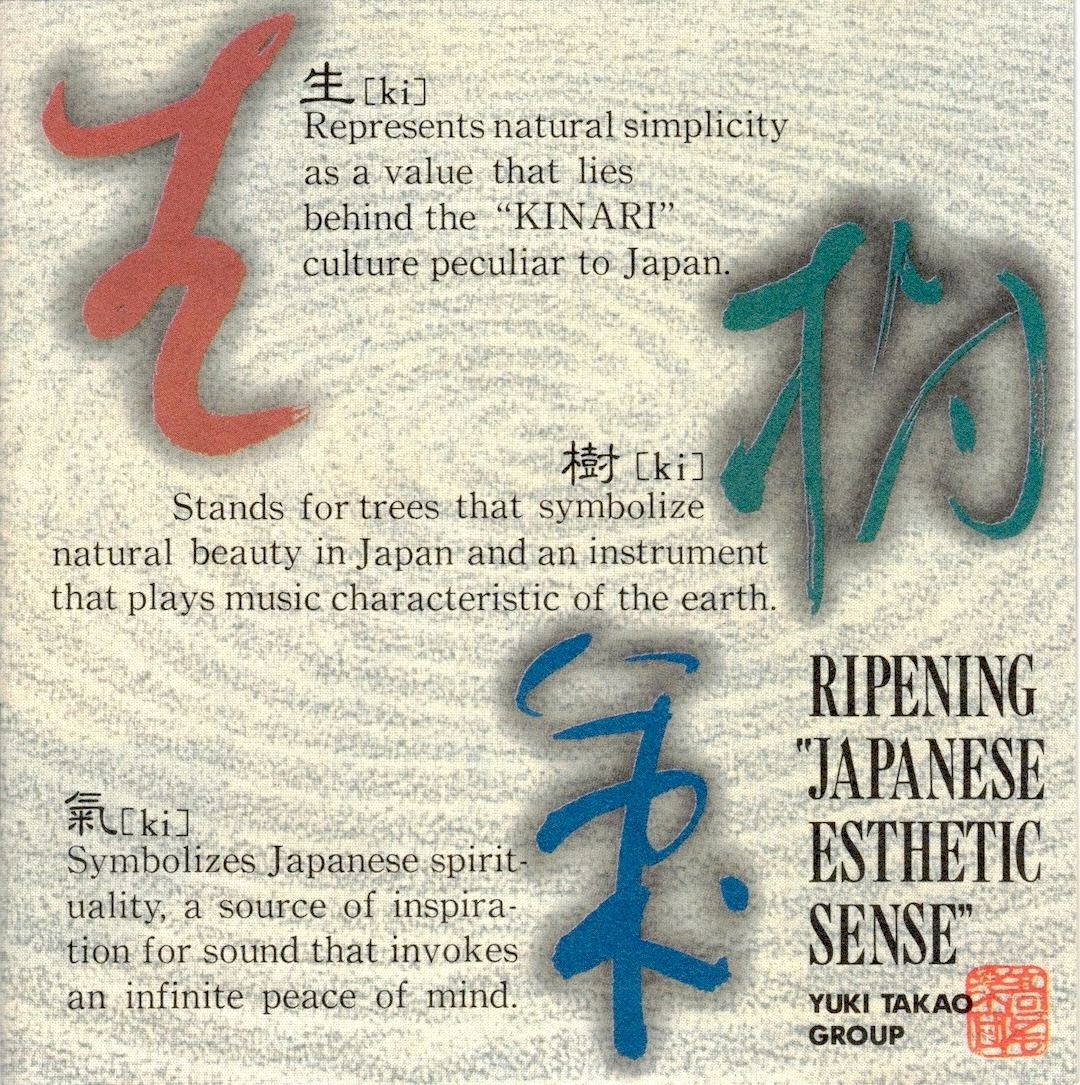
In the end, that ki — that word for simplicity, life force, spirit — lies at the core of this album, on its face and in its sound. It leads me away from focusing on what I could have: that many of those involved haven’t heard from Yuki in over 30 years, that her whereabouts and other works (if any) remain unknown, that there is still more mystery than history.
Instead, it leads me to another ki: keep. Keep it simple. Simply put, here’s another record by a special artist whose full story we hope to hear one day. For now, we’ll do our best to hold on to this one or at least roll that stone just one cycle forward.