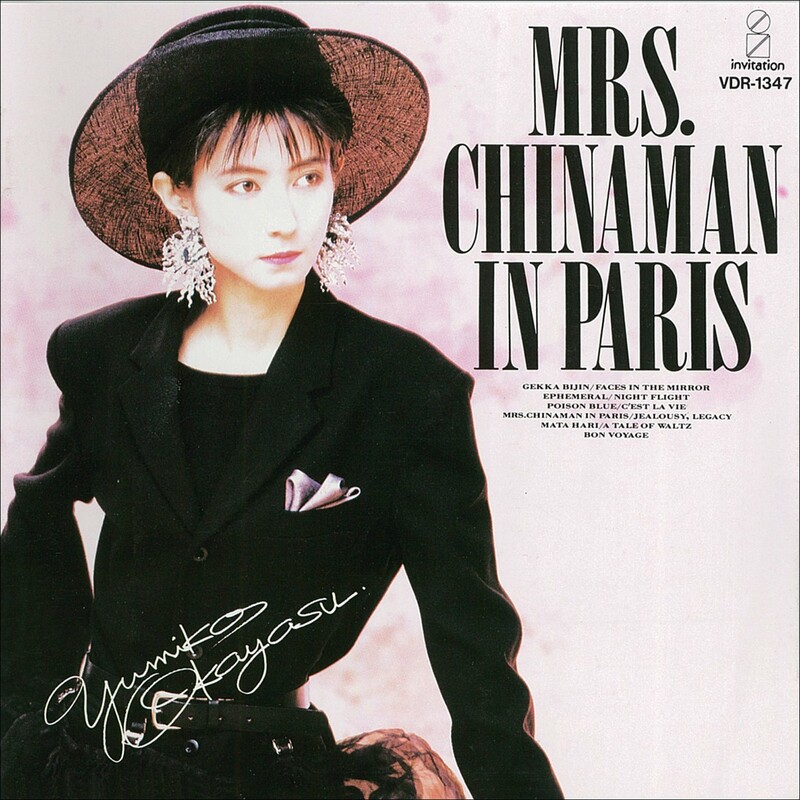
What can I say? When the first thing that greets you in someone’s bio is that their occupations have included actress, singer, race car driver, and now race car team owner, one figures this person is not your run-of-the-mill musician. Yet listening to Yumiko Okayasu’s Mrs. Chinaman in Paris, one gets the sense that, as a singer, her ideas are equally more than just the sum of their parts. A wild collection of songs oscillating between ornate and downright experimental, it’s a fitting final musical statement from someone who grew into herself.
A native of Tokyo, born Hiroko Okayasu in 1961, Yumiko was the eldest of three siblings in a middle-class family — the only one struck by the performance bug. Although, like many young Japanese, Yumiko took classes in music and art, it was her love of theater and movies that led her to develop a knack for acting. Small and waifish-thin, desperately shy, and a bit of a tomboy, in her youth many mistook Yumiko for a young boy — something she’d use to ingratiate herself with “bad boys.”

By the time she graduated from Tokyo’s Joshibi University of Art and Design, Yumiko had come into “performance” from a learned background. What began as a child’s study turned into an adult’s yearning to be something more — someone famous.
On the streets of Harajuku, at the dawn of the ‘80s and under the influence of punk and New Wave, Yumiko gathered and created an all-female theater performance group from her university, which they dubbed “Secret Society G.” They performed for passersby, and it was in front of that Shibuya mainstay of the alternative scene that Yumiko gained her notoriety and was discovered as the “Queen of the Streets.”
At the age of 24, in 1985, Yumiko made her big-screen debut as part of the cast for the filmed adaptation of クララ白書 (Kurara Hakusho), a popular light novel at the time. That same year, she went solo and released her debut 夢への接続詞 (Conjunction to Dreams) — a startling selection of tunes that trapeze between New Music, art pop, post-punk, and Kayōkyoku. She worked with left-field talents like Kazuhiro Nishimatsu from Aragon, Godiego’s Mickie Yoshino, and the smooth-as-butter Kenjiro Sakiya.

Appearing as a presenter on Fuji TV’s オールナイトフジ (All Night Fuji) variety show, she took over from Naomi Akimoto as the program rebranded itself — less a risqué, hypersexualized late-night show and more a vehicle to market music, music videos, and pop idols. It was on Japanese screens that viewers experienced the video for the B-side of her first single, “Show Me Everything.”
Far from adopting the image of an innocent J-idol, Yumiko instead embraced an androgynous look — cutting her hair short and channeling a scene and sound inspired by the cutting edge of the European art pop world. On record, songs like “Yellow Moonlight” and “Lonely Girl” revealed a vocalist with the range to tackle sophisticated song styles, while “Sensation” and “夢の回廊” felt part of the electronically tinged Japanese art rock that better-known names would later attempt to cover.
It’s this fascinating debut that makes her sophomore release feel like a bit of a stumble. Perhaps driven by her record label or newfound fame on stage and screen, 1986’s あぶないセクシー・ガール (Dangerous Sexy Girl) felt like a tongue-in-cheek play to those who didn’t know she was more than that. At the height of her cultural relevance, all the milquetoast songs on that record seemed to serve no one but her label and Subaru, who used its single to soundtrack their commercials.

What 1987’s パリの中国人 (Mrs. Chinaman in Paris) presents are the rumblings of acceptance — that her music had to find new contours. In hindsight, one hears Yumiko taking cues from French chanson and pop. Others might detect strains of the purple one’s askew soul on Sign O’ The Times, or the danceable progressive New Wave of Kajagoogoo and Kate Bush’s Hounds of Love. Heck, as evidenced by album closer “Bon Voyage,” the shapeshifting pop of the Mael brothers seems to have been a heavy influence. It’s a record impossible to pinpoint stylistically — because stylistically, Yumiko appeared to shift perspectives often, just enough to keep us from expecting anything.
Fresh off sessions from Mickie Yoshino’s American Road, Mickie and guitarist Tsuneo Matsumoto were invited to introduce muscular, largely acoustic, wind and string instrumentation — filling in contours that vibed with the more progressive sounds of the ‘80s. Lead single “月下美人 (Gekka Bijin)” pulled off that decidedly cosmopolitan, continental-sounding vibe that lingers throughout the album.
Looking back, it’s no wonder that such a release remains fairly lost to critical acclaim — a hidden gem. Yumiko pulled off, in plain sight, something peculiar that might have been lost to mainstream audiences — and, for audiences that would have been into it, created something they might not have expected from such a cultural mainstay.

Luckily for us, it’s that looseness of pretense that allows Yumiko to power through multifaceted songs like “鏡の中のエクスタシー (Faces in the Mirror)” and to insert ethereal overtones into songs like the starlit ballad “エフェメラル (Ephemeral).” Swinging numbers like “夜来香 (Night Flight)” take inspiration from a headier time, clocking their influence from Shōwa-era big band jazz. “ポイズン・ブルー (Poison Blue)” expresses its high drama through progressive pop, once again squeezing many movements into a compact four-minute song.
What Yumiko projects as a waifish, elegant starlet on the album cover, she disorients by saddling with the album name, and she reorients with equal measure in the muscular, angular punk of songs like “セ・ラ・ヴィ (C’est La Vie).” And on the album highlight “パリの中国人 (Mrs. Chinaman in Paris),” the title track presents a sonic version of all her chickens coming home to roost.
Equal parts sophistication and disorientation, a single distorted guitar track cuts through a Parisian atmosphere as Yumiko plays the role of an actress of sorts. In the lyrics, she speaks of “becoming a different woman every time she crosses a border.” パリの中国人 (Mrs. Chinaman in Paris) is a masterclass on how she’s able to absorb and subvert the boundaries of chanson and European art rock and infuse it with influences far from its borders.
You hear it in the final tranche of songs — “マタ・ハリ (Mata Hari)” mutates the “Eastern”-sounding avant-garde of bands like Siouxsie Sioux and The Banshees or Japan’s own Ippu-do. The gorgeous and plaintive “ワルツ伝説 (A Tale of Waltz),” an intimate ballad, touches on the new neofolk tradition, reimagining Pre-Raphaelite music in a way that speaks to Yumiko’s post-modernist vision.
As a child, Yumiko created abstract paintings that belied her age. Later, on what would sadly turn out to be her final album, Yumiko created another abstraction fitting her maturity. Behind the mask, underneath the attire, below the rim — multiple things could fit right at once and reveal themselves better on skin surface. On パリの中国人 (Mrs. Chinaman in Paris), Yumiko finally squared the musical circle she always needed to.