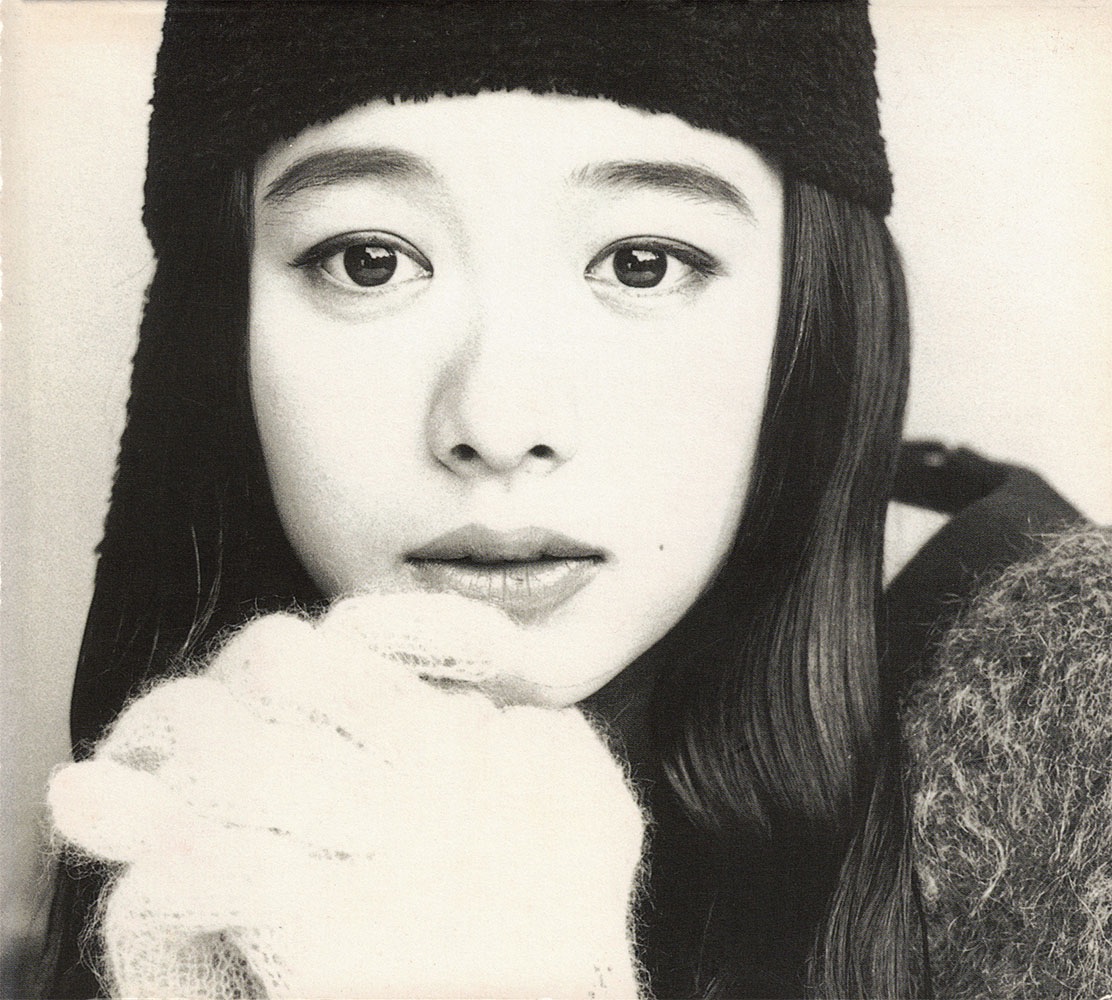
There’s something masterful about the black-and-white photo adorning the cover of Nae Yūki’s masterpiece: 水の精 (Water Spirit). A portrait of the artist, it shows Nae wearing a knit cap, gloves, and a heavy sweater, her large, expressive eyes offering a direct view into her personality. So committed to her persona, you’d never guess the full gamut of emotions she was expressing were captured on some hot summer afternoon. It’s the kind of image that triggers a thought: Am I only now seeing what others have always seen in her?
For keen film viewers, Nae’s name might already be familiar. As an actress, she has appeared in memorable roles in David Lynch projects like Inland Empire and Twin Peaks: The Return. In the former, American audiences first encountered her as an Angelino streetwalker who–within Lynch’s surreal universe–delivers one of its most poignant scenes, emoting through those same eyes an otherworldly fusion of frailty, resolve, and surreal lightness that’s unmistakably hers.

Years later, when Lynch invited Nae to appear in Twin Peaks: The Return as Naido, he obscured those same eyes in heavy makeup, almost as if challenging us–and her–to unsee that first impression. The role, arguably a visual critique of Asian fetishization, allowed Nae’s largely nonverbal performance to reveal another dimension of her craft.
For those music fans wondering what this has to do with 水の精 (Water Spirit), let’s shuttle back to another beginning. Before Nae left Japan to pursue acting in America, she was Nae Tazawa, a young girl born on the outskirts of Yokohama and raised in Seya-ku in the ’70s. After her parents’ divorce, she was placed in the care of her grandmother. In what must have felt like a tin-can dream and escape from that dramatic reality, she imagined becoming an actress like the performers she saw on film and television.

Producer and acting coach Tomio Hoshino, combing through headshots, plucked out a photo of this precocious middle schooler whose eyes exuded a singular aura. For a year he tried to persuade her to visit his agency, only to be rebuffed. Free-spirited and intent on cultivating a new kind of pop star, Hoshino persisted. Eventually, when Nae signed on, she dove headfirst into acting, appearing in slightly polemical early-’90s coming-of-age films like 曖・昧・Me, choosing to take difficult roles others her age would normally shy away from.
On the strength of that debut, Sony came calling, hoping to mold her into their next faceless J-pop idol. Major corporations like Fuji TV enlisted her for wildly successful dramas such as 北の国から (From North Country) and for hosting 裕木奈江のオールナイトニッポン (Yuki Nae’s All Night Nippon). Within three whirlwind years, she achieved a level of fame her younger self could scarcely have imagined.
Unlike many rising idols who leaned into ingénue innocence, Nae embraced roles that risked making her unpopular–even “nasty” in the public eye, even if they jeopardized her career. In 北の国から (From North Country), she portrayed a woman unapologetic about having an abortion. A year later, in 1993’s ポケベルが鳴らなくて (My Pager Isn’t Ringing), she played a travel agency worker who seduces her older boss. In the early Heisei era, these roles sparked backlash from conservative women’s groups and tabloids, who branded her a bad influence–even as she appeared in countless commercials for brands like Nintendo and others.
Arguably, it was her music career that suffered most from these professional acting risks. Early releases such as her 1993 Sony debut a Leaf and its follow-up 森の時間 (Forest Time) cast her as the safe country girl, making gentle songs palatable to sweet high schoolers and their aunties alike, tempering her true personality from a wider audience. Her biggest hit, “拗ねてごめん (Sorry For Being Sulky),” told you everything about that positioning. For many who knew her from her acting roles, her deeper strength felt muted in the music realm to appease mainstream expectations. However, to understand the dramatic shift from 1993’s mainstream 旬 (Shun) to 1994’s 水の精 (Water Spirit), one must look to the artistic risks she was beginning to take elsewhere.

In 1993, Haruomi Hosono was invited to contribute to a Shuji Terayama tribute compilation. Around that time, he encountered a scathing article criticizing Nae’s acting in ポケベルが鳴らなくて (My Pager Isn’t Ringing). Intrigued, he sought her out. Meeting her in person, he saw what few others did: behind those eyes was an artist hungry for work that reflected her true sensibilities.
Together, they recorded “ロングロングアゴー (Long, Long, Ago),” a stunning track that reoriented Nae’s vision of what her pop music could become. Between her more conventional album sessions, they continued crafting experimental pieces like “Star Song,” later included on compilations inspired by Kenji Miyazawa’s cosmic poetics. As Haruomi would relate elsewhere, meeting Nae inspired something in him:
“I believe that drawing as close as possible to the laws of nature is what people envision as their ideal future selves. ‘Pure, righteous, and beautiful’ may not refer to the human world at all, but rather be an expression describing this kind of energy that is closest to the primordial. […] Many people are now facing a time of trial amid frustration, and have begun to realize that they have either abandoned or forgotten something important in their hearts. Yūki-san must be someone who stirs those people. That is surely why the great forces of nature are cheering her on.”
Unbeknownst to Nae, Hosono shared these recordings with his former Happy End bandmate Takashi Matsumoto, inspiring Matsumoto to resume writing lyrics after a long sabbatical. He reached out to Nae with an invitation: would she make her next album with him as producer, venturing into this more exploratory direction? A devoted Happy End fan, she found another dream unexpectedly fulfilled. Exhausted by label politics and between agencies, she embraced the opportunity.

In retrospect, it’s astonishing: Hosono and Matsumoto enlisted Shigeru Suzuki, effectively reuniting much of Happy End (sans Eiichi Ohtaki) for Nae. They assembled a murderer’s row of veterans–Haruo Kubota, Miharu Koshi, Masaaki Ohmura, Akira Inoue–alongside contemporaries like Akiko Yano and Yukihiro Fukutomi. The result was a pop record that anticipated an unpredictable future. Yet what should have marked her reinvention faltered amid label machinations.
Released quietly in 1994 with little fanfare and zero backing from Sony, 水の精 (Water Spirit) was dismissed as too “artsy” for them to promote. Takashi himself would have to take the photo that would adorn the record. As for those who found it, opener “月夜のドルフィン (Dolphin In The Moonlit Night)” still remains as revelatory. With atmospheric grooves from Masaya Matsuura and Yukihiro Fukutomi, Nae’s vocals drift into environmental pop terrain previously unheard in her catalog, wandering into nascent territory spirited forward with other artists like Dream Dolphin and POiSON GiRL FRiEND from that time.
Dub-tinged “宵待ち雪 (Snow Waiting For Nightfall),” arranged by Hosono and Miharu Koshi, showcases her shapeshifting instincts. The luminous ballad “恋人たちの水平線 (Lovers’ Horizon),” arranged by Suzuki with backing vocals by Rajie, channels the poised melancholia of Françoise Hardy, groups like the Cocteau Twins, or someone like Enya into new starlit folklore befitting Nae’s unique, serene resolve, predicting countless strains of future pop that’s topping social media streams everywhere. It’s the accumulation of all these small surprises that justly make the album a quiet favorite, a “musician’s musician” album if you will, among those who revisit it. It’s no wonder, that to this day many of those involved remain genuinely surprised by the lack of critical recognition.
Fans of Seishiro Kusunose may delight in hearing him back Nae on “めかくし (Blindfold),” updating his quasi-psychedelic, dayglo sparkle for a more subdued/alternative Heisei-era mood. The album’s sole single, “空気みたいに愛してる (Loving You Like Air),” comes closest to convention yet still layers in subtle experimentation. A newfound maturity in her voice emerges on “鏡の中の私 (Me In The Mirror)” and “すっぴん (Bare Face),” confronting the weight of the male gaze on herself and other young women.

The record closes with equal elegance. The languid “サーブ・アンド・ボレー (Serve And Volley),” arranged by Masaaki Ohmura, carries a refined atmosphere suited to her velveteen vocal timbre. Hosono’s final contribution, “時空の舞姫 (Dancing Princess Of Space And Time),” unfolds like a music box spinning between imagination and afterlife, faintly recalling Kate Bush’s best work. Finally, Akira Inoue and Akiko Yano’s heady, jazz-inflected arrangement of “風の音 (Sound Of The Wind)” brings the album full circle, her voice floating through impressionistic lyrics about finding courage reflected in nature.

Not long after the album’s release, Nae would slowly withdraw from both music and acting to protect her mental health. One can’t help but wonder where her path might have led had she been granted more time and encouragement to follow all those horizons in front of her own line of sight. It wasn’t until the new millennium that she fully rekindled her love of acting, relocating to America and once again risking reinvention to follow one of her muses. As more listeners rediscover this bold artistic leap, perhaps we can convince Nae to turn her gaze back toward that other one left in our memory: her unique music.
Leave a Reply