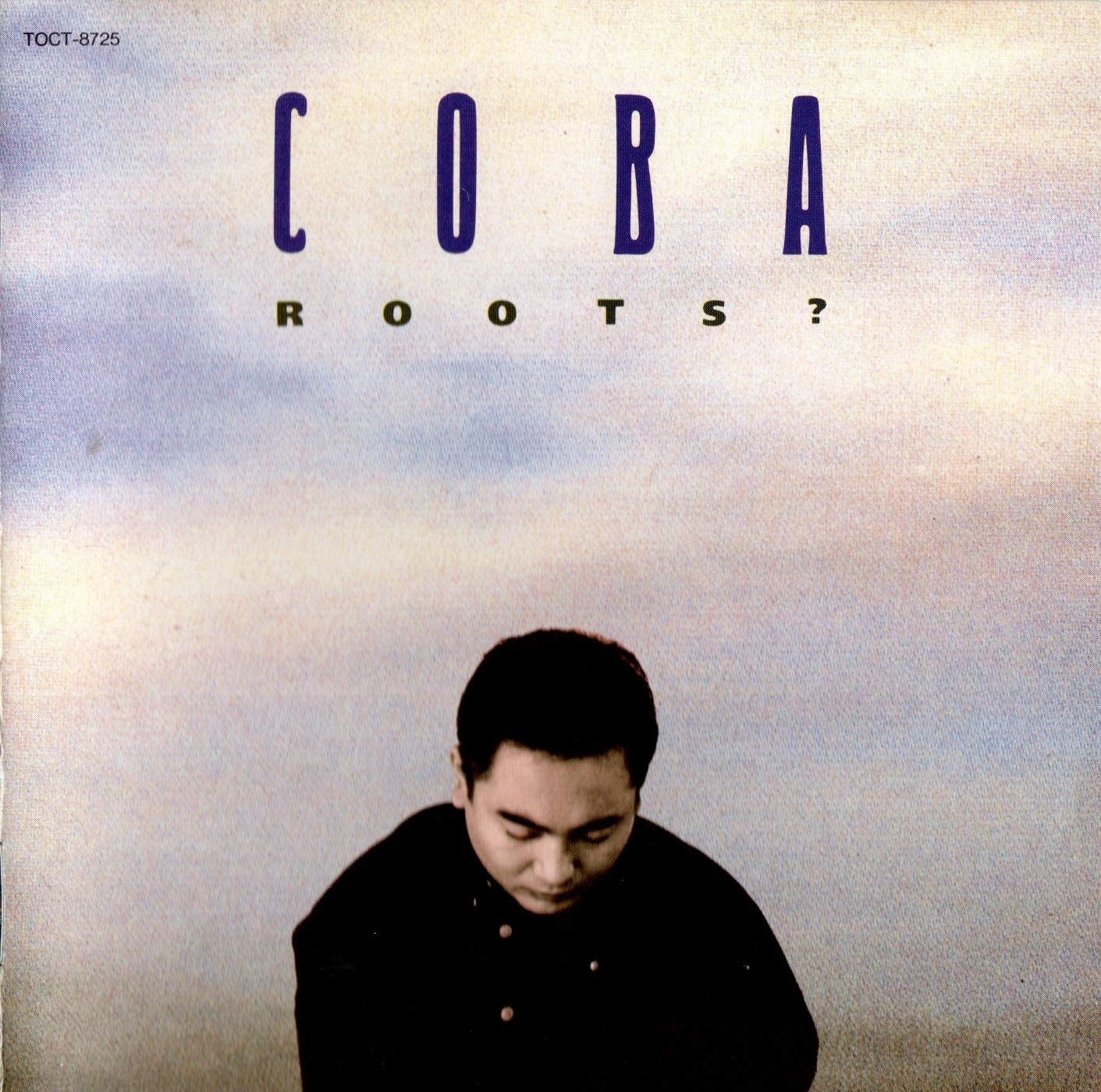
There’s a seemingly unwritten line written in music. It’s between those whose aim is to recreate the past and those whose gaze only turns towards the future. Yet, in my favorite music, I see that there is a third way: it’s found in those who straddle both sides, who choose to use their feet to blur the line and throw dust in the air. Yasuhiro “coba” Kobayashi’s Roots? perfectly posits the question and uses his music to answer this question.
If you know anything about Yasuhiro it’s this: accordion player. Never pictured too far away from his notable instrument–it’s that “chosen” instrument that has taken him in directions not many musicians would have taken.

Before Yasuhiro became coba, before he became an internationally-renowned musician and instrumentalist appearing with huge artists like Björk and U2, there was a young boy from Niigata whose gifted ear for music was sent on a wild goose chase. One day after coming back home from elementary school, he found a small birthday gift waiting for him: an accordion.
Rather than react with surprise or joy, as most kids would do, he felt sadness overcome him, so much so it made him cry in disappointment. This was not like the piano he always imagined playing on. For years he heard his father play a much bigger version of it–accordion playing was his passion. In Yasuhiro’s eyes it felt like an instrument for the elderly, a hand me down, an instrument of the past. At that moment, he couldn’t appreciate the gift.

For six months, Yasuhiro would leave it in his case. One can imagine how much his father must have felt hurt by Yasuhiro’s reaction. Then, one day Yasuhiro opened it up and put it close to his body, playing his first notes through it. Pressing the bellows and keys, feeling its vibrations close to his heart and chest, he felt captivated by this instrument in a way that felt like it was alive. It was then that Yasuhiro took it upon himself to take this instrument and learn it inside out, transforming it to a “cool” instrument as guitarists would in the prog bands he was into at that age, even if he didn’t quite know how to get it there.
Yasuhiro’s journey would take him to Italy at the age of 19. It was at the urging of his high school’s music director, who recognized his talent, that Yasuhiro heeded his advice to not worry what people think and go abroad to take his accordion study seriously, as there were no Japanese artists for him to learn and gain inspiration from at home. Soon afterward, Yasuhiro convinced his parents to let him take a sabbatical and land in a small rural village outside of Venice where he would live and attend the Scuola di Musica Luciano Fancelli and study the canzone, tango and classical music he loved.

Thrown into the lion’s den, so to speak, Yasuhiro quickly found that he had to get up to speed, quickly. In a pre-internet era, in the late ’70s, he went from barely knowing a few phrases in Italian to immersing himself in the language so that he could fend for himself away from home. It was in Europe that Yasuhiro discovered huge influences that inspired new ideas in his accordion playing. Discovering the music of someone like Astor Piazzolla showed him there was a whole world of music that could be played with this seemingly outdated instrument.
After studying and practicing feverishly for four years, Yasuhiro graduated top of his class and in the ’80s followed a more traditional path to success, finding his legs as a gifted accordionist. Whether performing and winning in various stuffy international accordion competitions, or appearing as a session player for others, Yasuhiro gradually became an in-demand name with some degree of notoriety and fame under his name. By the time he came back to Japan, in 1992, to land his first record contract, he could have done just enough to rest on his laurels so to speak. Early songs like 1994’s “Sara” became a hit with the Japanese café crowd but felt stuck mostly in the past.
Yet, how funny is something called: history? Looking at his credits one senses an artist trying to find a way to escape any pigeonhole. Whether working with cutting-edge artists like Jun Miyake or others like The Gentle Wind, Clémentine, and Yuki Saito (to name precious few), Yasuhiro’s own choices of who to work with gravitated towards the alternative. And although his first records under his own name were met with a bit of indifference from Japanese critical circles, one wouldn’t fault his effort.
By the mid ’90s, Yasuhiro journeyed towards a new direction. Choosing to go by the stage name “coba”, Yasuhiro relaunched his career with an eye towards creating more contemporary music that would allow him to express the vitality of his chosen instrument rather than what’s expected.
Early records like 1993’s 33giri and 1994’s Surfin’ Music found coba searching for what exactly this other identity would be. Would it be a fusion of jazz and world music or something looser and more urbane? And as life happened while he was busy figuring that out, in 1995 fate would have it that one Icelandic artist by the name of Björk caught wind of this fascinating accordionist while performing in London and invited coba to accompany her on stage and in the studio as she’d perform her versions of Post on tour with a distinctly coba flavor and later on form some of the influence directing her on tracks she’d debut on Homogenic like “Hunter”.

It was while performing on tour with Björk that coba began to understand the new rootless music he was aiming for. Setting aside the world of world music, in myriad dancefloors a new concept held a seed for his music. Inspired by the burgeoning IDM and club scene, much like his idol Astor Piazzolla, he too completely shifted his vision realizing that there was a new there, there to explore.
Although released in Japan in 1995, coba’s Roots? lay elsewhere with recording sessions scattered across Tokyo, Milano, Paris, and Paço de Arcos, Portugal. Tuning out the noise made by other people, coba created this groundbreaking record that understood the strength in being a bit rudderless and uprooted.
Opening track “Sayonara” speaks literally to coba’s meditation of identity. Featuring an intriguing mix of downtempo, tango, rap, and lord knows what else, it sounds like a snapshot of coba’s internal wrestling with his visionary intention. Working with a mix of French, Italian, and Japanese musicians who teased out the impressive fluidity within coba’s arrangements, every bit of Roots? sounds like little else anyone chose to do with his chosen instrument.
Take a listen to “Paris”. What was once a young man trying to fit the bellow of his instrument in the works of others, now you hear one in full flight, finding that spirited “French Touch” could also fall under his nimble fingers. French greats like Les Rita Mitsouko would contribute on the fiery, epic “Peut-Être Ce Soir” chanson. Other songs like the impressive “Tameiki Cabaret” bring forward coba’s updated, alternative form of tango, one surely his idol Astor would have appreciated.
What’s there to say about songs like “Sougen”? Songs that take the influence of African and Latin music into coba’s more leftfield orbit. Another album highlight, “Koi-Gensō”, luxuriates in sussing out a whole bunch of askew beauty out of dark, almost-motorik-sounding techno music. The most impressive thing to hear is how each song would lose something unique and important if you took out coba’s accordion. If you listen closely there are the ghosts of these instruments past blowing through his playing.
Pedro Ayres Magalhães from Portuguese post-punk pioneers Heróis do Mar would contribute “A Promessa” allowing coba and Portuguese vocalist Teresa Salgueiro to bring some dreamy ambiance to this longing fado song. And that’s the way the record goes. Every new track introducing new angles coba could express in not just his instrument but in other contemporary styles and in “traditional” folk music from many wordly expanses. For every seemingly simple-sounding song like “Stormy Night”, you hear it shapeshift into something else, something with a cutting-edge.

Future albums would find coba pursuing new horizons, working with artists as diverse as Plaid and Towa Tei. Yet lost in all that head-spinning timeline is just where it started, where coba found that breath of fresh air, that new breath in his instrument. Of course, much like him, all it takes is for you to press a few keys to discover this.
Leave a Reply