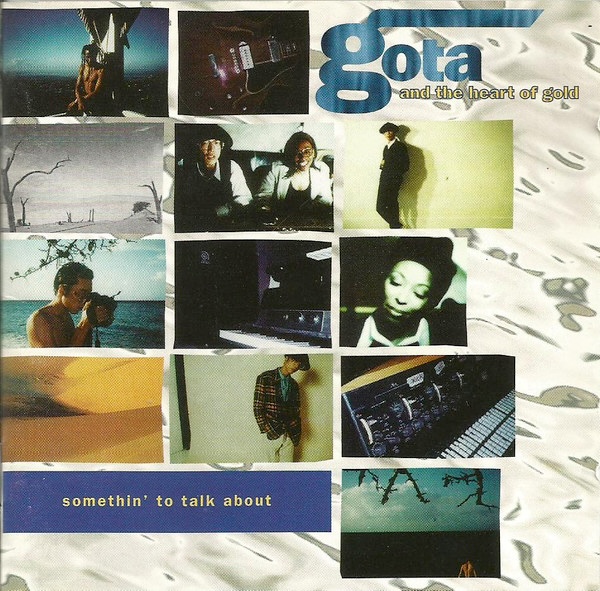
If one can come up with a phrase to chart Gota Yashiki’s life I think it’s this: Choose your own adventure. Dig into his career or his life and you find someone at the center of so many wonderful discoveries and enlightening journeys and side quests. The more I listen to Gota’s Somethin’ To Talk About, the more I have to coax myself to stop getting lost in its groove and finally do something about him.
Before Gota quietly revolutionized our contemporary R&B scene, before he became the masterful drummer, producer, multi-hyphenate musician he’s now known as, there was a young man born in nowheresville, rural Kyoto prefecture, who grew up in the ’70s surrounded by mountains, working at his father’s okonomiyaki restaurant in Ayabe, a “cartoon-like” edifice built from corrugated aluminum right by the train tracks.

Gota’s father, always the entrepreneurial kind, didn’t have a license to sell alcohol, and to find another way to sell something to the interesting characters that frequented his establishment — long-distance truckers, manual laborers, auto mechanics, assorted hippies, and more — caught wind that there was money to be made on selling 8-track tapes. Eventually, he’d open up an 8-track rental shop and put Gota in charge of the place, hawking and repairing tapes to the offbeat people into the music.
What came to cultivate his love of music would be those conversations he had with such people who turned him on to all sorts of music that fell outside of Japanese radio. By the time Gota also encountered festival drumming he heard booming from Japanese shrines, he knew something was stirring in him. At home, he’d listen to the work of musicians like Art Blakey and dream of being in a cool rock band like the older buddies he hung out with.
In the beginning, Gota’s first attempt at drumming came via joining local Ayabe Taiko groups and then with his dad, a drummer himself, who taught him at first. However, by the time he went to high school Gota almost quit drumming after tuning into a performance of Bob Marley and The Wailers, realizing how what he was doing was so far behind. What ultimately spurred him to take this seriously was by joining a brass band competition and realizing that he had to put the work in to learn drumming fundamentals through and through.
The quiet, hard work that would typify what it took him to get ahead in life, would eventually lead Gota to drop out of high school, taking all the money he saved working in his family’s now uptown Kyoto City coffeehouse, to buy the best drum set he could. At that moment, Gota knew he wanted to become a professional musician but life in the bigger city didn’t immediately translate to success. He gave himself two years to succeed or try something else.
In Kyoto the bands Gota would join all wanted to play prog, fusion, or other styles where drumming played a background role. Gota’s own taste gravitated at that time towards black music, inspired by the soulful sounds of R&B, reggae, and funk. An avid gamer at the time, Gota also felt inspired by Nintendo and video game music, enough to realize that he’d want to tap into this electronic side of music, as well, becoming self-taught in computer music production and CV, then MIDI programming. In the end, it was his older, more open-minded girlfriend of the time that strongly suggested that they needed to go to Tokyo where he might have a better chance of finding people more up to his speed.
That decision to follow her to Tokyo would lead to the space in history where Gota was able to chart his own course. It was in Tokyo that together with Kazufumi Kodama, they’d create the band Rude Flower which would become the Mute Beat group that would explore Japanese-created reggae and “soul” music. In a whirlwind of a time, early performances as Mute Beat would introduce Gota to members of the Melon sphere of influence like Yann Tomita, Toshio Nakanishi and others, who saw in him a kindred spirit in style and music. Eventually they’d find the visionary Major Force label to gather other spirits. Then together, as the Water Melon Group, they took their groove influences elsewhere on albums like Pithecan Thropus Erectus, a name inspired by both the fabled Tokyo jazz club they all met and played in and the Mingus album of the same name.
Gota’s impressive exploits behind the drum kit and on new-fangled drum machines and samplers would eventually lead him to Europe where a Melon performance in Italy led to a certain bit of buzz. For a moment Virgin Records nearly signed them as their first Japanese act they’d try to break through elsewhere. Eventually, Sony Japan would finance a six month recording session in London at Trevor Horn’s ZTT studios for what would produce 1987’s Deep Cut.
A week before returning to Japan, Gota would have a whole week of free time to spend in England. Gota relates in an interview walking around the rural and verdant New Forest District and feeling a sense of connection with it like he had with his Ayabe City. Although Gota would come back to Japan, his mind remained stuck in England. It was in England where he felt a lot of his early musical inspiration was and in its multicultural society, with all its warts, that all sorts of new musical ideas were being born. Shortly, at the moment both of his groups Mute Beat and Melon were making their ascent in Japanese popularity, Gota took a year long sabbatical to head back to London to the surprise of all involved.

In 1988, when Gota first re-arrived in London, he reached out to one time acquaintance Nellee Hooper. The two had met years before in 1985 when Nellee Hooper was in the group the Wild Bunch. At that time, Nellee was impressed by Gota’s keen sense of fashion, as he was spotted often sporting dreadlocks, decked out in early American-inspired streetwear with his now-signature Kangol spitfire hat and oversized eyeglasses. Frequently Nellee would appear in Melon sessions simply vibing out with him. Even if Gota hadn’t quite mastered the art of speaking in English, Nellee would or could be the person that understood what Gota could offer.
If ever you’ve worn out the groove to Soul II Soul classics like “Keep On Movin’” or “Back To Life” you’ve already encountered the work of Gota Yashiki. It’s his visionary beats which didn’t have a name yet but would most be widely known later on as UK Soul until it would transition into acid jazz and trip-hop, that he’d create and program the music for — even if he didn’t get the full credit he deserved for them. It wouldn’t be until years later that his work here would be recognized at home as the originator of the so-called Ground Beat (グラウンド・ビート).
Working for a pittance with Nellee, Jazzie B, and Caron Wheeler, in London, using ideas Gota had experimented with in Japan, all involved imagined and cultivated this new homegrown sound. When word of mouth spread of this young Japanese musician helping create such music, producer Stewart Levine, best known for his work with Simply Red, according to Gota’s account, reached out to him to produce, program, and create, what became Sinead O’Connor’s most known work, “Nothing Compares 2 U“, even if he was just paid a standard fee without accreditation. One work he would get full credit for during this time would however be Kyoko Koizumi’s impressive No. 17, which he helped record in London with his friend, musician and designer, Hiroshi Fujiwara.
So as word spread even further of Gota’s work, Gota would find himself sharing studio time with others like Bomb the Bass (whom he’d end up touring and producing with), ABC, Lio, and even Seal on his “Crazy” single. By 1991, Stewart convinced Gota to join Simply Red as both drummer and producer (even if, once again, he wasn’t fully-credited) after frontman Mick Hucknall heard of his contribution to Soul II Soul and understood what he could do with their group. On music videos for singles from the album Stars like “Something Got Me Started” you can see Gota make his first appearances with the group from behind the kit, showing his now seamless fusion of drummer and drum machine. And in the span of two years, what seemed like a pipe dream at first — to make his life in England — had become Gota’s reality.

Yet for all of Gota’s impressive work behind the scenes, one could sense there had to be a time when he would have to step forward. 1993’s Somethin’ To Talk About always felt inevitable. For all his work with others, there was just this much larger rhythmic world that others had barely scratched the surface of. And for a very brief time in London, Sony financed sessions where Gota invited huge names like Bernie Worrell of P-Funk, lovers rock royalty like Carroll Thompson, friends like Heitor T.P. and Mick Hucknall of Simply Red, Kenji Jammer and Richard Barbieri to flesh out his vision of groove music.
Originally conceived of as a joint UK and Japanese release, everyone’s first introduction came via a promo-only 12″, a club song, a remix of future album track “Changes” featuring Carroll Thompson. Released solely with “It’s So Different Here” on the flip side, Gota’s profound reimagining of Rachel Sweet’s little-known 1978 Akron power-pop as a deep soul cut, it quickly became a foundational Ground Beat song among Japanese 12-inch collectors who metaphorically lost their minds on this forward-thinking club track.
When you listen to Somethin’ To Talk About you can’t help but predict a certain slice of future dance music. Before artists like Nujabes or Kiyotaka Fukagawa’s Calm could fly, there had to be musicians like Gota to show the start of the way, to show its rudiments and fundamentals, by introducing ideas from the rare groove scene, being unafraid to mix them with UK’s new funky dance and urban scene, drawing inspiration from Latin and African music, all while not forgetting the club crowd, then finish them up by rolling them up in his own homegrown electronically-inspired craft, to show that Japanese musicians could pull this whole thing off.
Mixing live drumming with programmed grooves, opening cuts, like “Move” on the UK version (which I’m sharing today), effortlessly shift from all the moods of funk, showing that album wasn’t made by siloed-off sessions musicians but by those involved feeling and feeding off each other. The album version of “It’s So Different Here” expresses the best part of acid jazz, its intimate sophistication, a certain something that fellow Kyotoite group, Mondo Grosso would draw obvious inspiration from. Other songs like that cavernous groove of “European Comfort” take Kool and the Gang’s “Summer Madness” to impressive new territory with a Moog lead that’s as mouthwatering as it is delicious.
To promote the release of the album, “Someday” was put forward as its lead single. Another should-have-been hit, one existing in that wonderful crevice between lovers rock, quiet storm music, and acid jazz. In hindsight, as much as Gota’s ideas contributed to his fresh take on R&B, one shouldn’t discount the large role Carroll Thompson played adding her voice to some of the album’s best tracks. Likewise, guests like Bernie Worrell, Richard Barbieri, Heitor, and Kenji Jammer, gamely approximated a tight band that understood all the inventive interplay required to create tracks like the cosmic-sounding funk of “Groove Ride (Funky Monk Series 1)” or on the sultry, downtempo of “All Alone”. Live performances by those involved, as the “Heart Of Gold” band, reveal a great affinity for each other, the songs, and Gota’s leadership in the pocket.
Looking back, I’m simply amazed at all the rhythmic colors Gota was able to conjure up so seamlessly on Somethin’ To Talk About. In a just world, this album should have set Gota up to be something like a Marley figure, a new figurehead, pointing to a new bit of the world ready to add a different flavor to the soul stew. Yet, how Gota would live on would not be through this wonderful music but his continuing work behind the scenes, aptly drumming for and producing others.

Although the original CD would only be released in Japan and in England, it would take four years before anyone in the United States got to hear the album, a remixed version that unsurprisingly went as high as number 15 on Billboard and No. 1 on the smooth-jazz chart. However, the die had already been set, and his biggest, unsung influence would come via his sample library CD, dubbed Groove Activator featuring Gota’s myriad, different grooves, single drum hits, and rhythms that would be sampled and reimagined, then resampled by countless hit producers and musicians. My hope is that by sharing this album we all can go back closer to the source, when and where he put his foot down to take center stage.
Leave a Reply