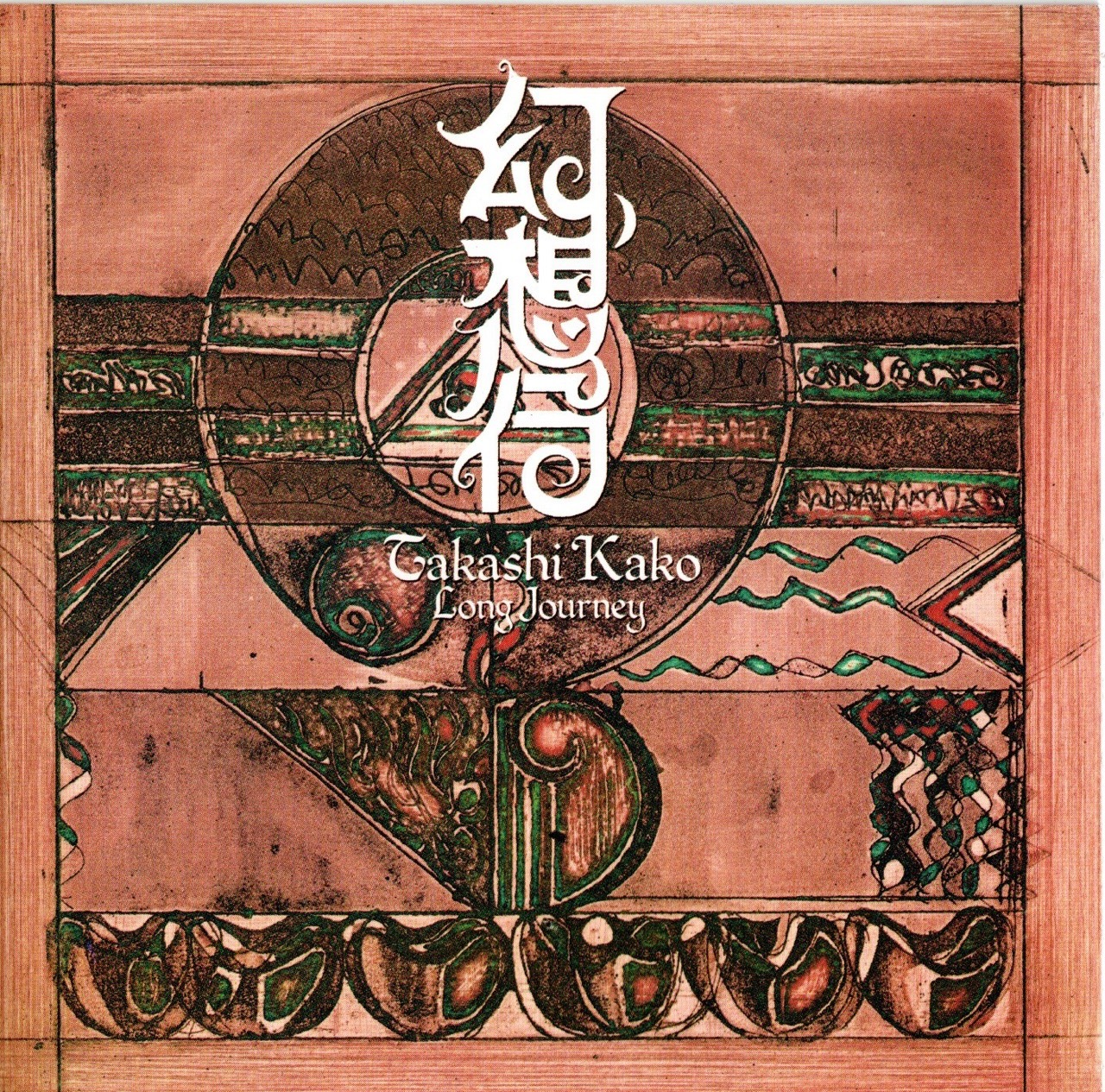
Recently, when I had an opportunity to speak with Yibing about my contribution to her radio show, Tranquilamente Radio, one important thing I brought up was this concept of “Mono No Aware” — the pathos of things. It’s about recognizing the weight and importance of how most of everything we experience in life is transitory and ephemeral. I did so because I firmly believe that there’s no reason the place we’re born in should dictate what fate has in store for us. In the end, I think one way I can communicate that is by sharing music showing there’s a richness that bears fruit when conversations between cultures yield new discoveries within them. And today, when I think of a great example of what this means, I turn to Takashi Kako’s 幻想行 (Long Journey).
Takashi Kako was born in 1947 in Toyonaka, Osaka, part of the first generation born after Japan’s defeat in World War II. Raised in a family with no musical connection and no money to afford him his own instrument or radio, his first love of music came from elsewhere. At the age of five, he discovered his first LP, Toscanini’s recording of Beethoven’s Fifth, at a neighbor’s house, one of the few homes that even owned a record player at the time. Takashi would later remark, “When I listened to it, I could imagine all kinds of things. I saw images of nature.”

For as many days as Takashi could steal away, he’d stay overnight listening to it until it finally lulled him to sleep. Back at his elementary school, a teacher assigning instruments noticed how quickly this kid picked up anything placed in his hands and encouraged him to pursue music more seriously through piano lessons, something he began at age seven.
From elementary through middle school, as Takashi grew up taking piano lessons, he’d continue developing his musical vocabulary by buying classical records. In this pre-internet way of building taste, Takashi relied on the recommendations of myriad unnamed record store owners, all wowed by this young kid so obsessed with collecting. In due time, his early love transitioned into contemporary music through the work of Stravinsky and into jazz, especially after hearing Art Blakey and the Jazz Messengers perform at Osaka’s Festival Hall. With each encounter, each new listening experience expanded his musical vocabulary.
As Takashi’s musical vocabulary extended, in many ways his own classical learning contracted. By the time he entered the Tokyo University of the Arts in 1965 to study composition, Takashi had become increasingly absorbed in jazz, until one of his mentors, Miyoshi Akira, refocused him, urging him to set jazz aside and pursue contemporary classical composition completely.
It was during those years that Takashi set jazz aside and immersed himself in the world of French modernism, serialism, and composers like Olivier Messiaen. By 1971, he had won a French government scholarship to study at the Paris Conservatoire under Messiaen himself, placing him on the path to becoming one of Japan’s next major classical composers. For a moment, he took Messiaen’s advice and turned away from Western-style music to explore what made him different: his Japanese sensibility. Yet over time, Takashi took that advice elsewhere and pursued other ideas.

It was in France that Takashi first heard the strains of free jazz. Something inside him clicked afterward. Free jazz was, in his words, “the world of improvised music where composition and performance proceed simultaneously.” Turning away from the siloing his mentors had imposed on him, he realized he could do that.
After Takashi won France’s prestigious Prix de Composition in 1976, early records on the Trio Records label like パッサージュ and Micro Worlds began building bridges between jazz and contemporary classical music. As a headliner, Takashi brought his impressive piano playing to stages across continental Europe. By 1978, he had followed the lead of his early jazz heroes and formed his own trio, TOK, with Kent Carter and Oliver Johnson. By 1979, he had signed with the storied ECM label, becoming its first Japanese artist and releasing TOK’s Paradox under their banner.
A turning point in his career came later that year. Performing for the first time as a solo pianist in Caen, northern France, he sought a shift away from mere European free jazz. Returning to Japan in 1980, he explored a more “Japanese” sense of freer jazz, releasing records that helped expand his homeland’s contemporary jazz scene.
Yet in February 1985, after three nights of solo concerts at Tokyo’s Seibu Theater, the music critic Noguchi Hisamitsu told him: “Just once, try taking up a melody that everyone knows.” In earnest, Takashi would record richly melodic albums like his hommage to Paul Klee, いにしえの響き -パウル・クレーの絵のように, and Poesie or L’Aube that crossed this boundary, featuring modernist pieces whose technical proficiency was married to emotion and musicality. Unsurprisingly, Poesie became his most popular release.

What’s startling about 1990’s 幻想行 (Long Journey) is how it wraps that entire arc of history back around to his beginnings. It’s his inborn musicality married to something more mercurial and magical. It’s about creating music tied directly to how he first fell in love with sound itself. In the original liner notes, Takashi expressed this:
The catalyst for making this album was that the instrumental arrangement for “Landscape” – a series of three connected pieces – finally took clear shape in my head.
When the initial idea for “Arabian Town” first came to me, the piece didn’t actually have a title yet. But the music itself evoked such a vivid sense of “Arabia” or “a desert caravan” – places I’d never been to or even seen – that I gave it that title without hesitation. And I felt strongly that this shouldn’t end as just a single piece, but should become something like a suite of at least three pieces. The idea was to keep a unified theme, or approach, while bringing out a different color and shade in each one.
“Landscape” means “scenery,” but not scenery in some vague, abstract sense. The theme is to take the natural surroundings and character of a particular country or land and express them through music.
That was the concept – so much so that even before I had composed the other two pieces, I had already performed “Arabian Town” as part of “Landscape” at an earlier solo concert. After that, the second piece was born from the image of the frozen plains of Northern Europe and Siberia, and the final piece comes from a longing for the vast expanse of Central Africa – circling around Lake Victoria and the headwaters of the Nile, its stories, and above all the hot, powerful rhythms of Africa. These are what form its motif.
Of course, none of this is musicologically verified – for me, these are simply things that feel Arabian, things that feel African, nothing more.
After completing the suite, I performed it many times in piano-solo and jazz-ensemble settings as well. But to truly bring out the scent of the earth, the sense of the land’s own character, I felt I really needed an arrangement of folk instruments – particularly folk percussion – that could express that fūdo directly. That’s how the instrumental lineup that forms the foundation of this album came together.
And then there’s another theme running through the entire album: the image of a “journey.” I wanted to let that idea expand even further. Not only journeys across geography, but more imaginative, fantastical journeys. Outward journeys, and inward ones. Nostalgia. A movement from the concrete toward the abstract. From those feelings, I gave the album the title 幻想行 (“Gensoko”) – and in English, Long Journey.
The closing track is Ornette Coleman’s “Lonely Woman.” In Japanese it has the ring of 幻想行 – “a fantastical journey” – and in English it carries an entirely different shade of meaning. I hope it brings this fantastical journey to a fitting close.

Working with three musicians steeped in France’s cross-cultural jazz scene — Jean-Jacques Avenel (bass and kora), Cheikh Tidiane Fall (percussion), and Nenê (drums) — 幻想行 (Long Journey) was less an attempt at creating “world music” and more an attempt at capturing something you really can’t translate: fūdo, the natural surroundings, character, and culture of lands that sometimes can only exist in one’s imagination. For three days in Yerres, France, from December 4-7, 1989, they performed and recorded together as an ensemble, having that internal, ephemeral conversation musicians share.
More than the concept of a three-part suite traveling through Arabia, Northern Europe, and Central Africa, it’s the way he performs as part of a group where each musician carries their own storied history. Four musicians, four traditions — Mandinka, Senegalese, Brazilian, and Japanese — none of the session players reaching for exotic effect, all of them carrying the music of history in their bodies. Takashi wasn’t gesturing toward a particular place, nor were they. Takashi’s goal was to gather musicians for whom “place” was already inseparable from performance itself.
Not quite jazz, not quite ambient, experimental, or world music, songs like opener “アラビアの町 (Landscape I – Medina)” and “ナイルの源流にて (Landscape III – White Nile)” express imagined Arabic-influenced music that evokes landscapes Takashi himself had never seen. Playing each song’s leitmotifs through what might otherwise seem like a rigid instrument — a Bosendorfer Imperial Model 290 piano — together they trace alternate land routes toward fantastical musical ideas. Tapping into the same good trouble Duke Ellington’s The Afro-Eurasian Eclipse spoke to, this was a cosmic cosmopolitan brew that set aside Takashi’s more experimental past for something closer to the heart.
Songs like “白夜 (Landscape II – Grand Nord)” use quiet atmospheric moments to drop you into the slipstream of universal music. Otherworldly jazz in the lineage of Pharoah Sanders or Ornette Coleman — whose “Lonely Woman” they cover here — hovers throughout the album, tuned into the same spiritual mathematics that animated the late, great John Coltrane. Released only on CD, much like Hiroki Tamaki’s 音楽浴 田園・・・・ラプソディ (Music Bath – Countryside… Rhapsody), Takashi’s own 幻想行 (Long Journey) remains a little-known/appreciated Japanese jazz masterpiece lost amid our tendency to fetishize record collecting.

You hear this snaking rhythmic feeling wrap around you on songs like “挽歌 (Lament)” — this idea that technology is nothing without the human hands creating meaning through it. Randomization is always a poor substitute for improvisation. Behind every searching bass line played by Jean-Jacques Avenel, there’s a reflection in Takashi’s piano trying to ground its lament. Behind every pattering drum line played by Nenê, there’s Cheikh Tidiane Fall searching for a way to float it into the unknowable. The fact that these musicians can play is undeniable. The fact that they are listening to each other is far more meaningful. Although it took a long journey for us to reach this, our destination, you know that old saying: “it’s not about the destination…” that matters. As for what’s missing, I’ll leave you to fill out the rest.